

You have your poles, the weather is nice and you are not sure how to begin? Good news: this is not a science. It is not about performance, or about walking “correctly” straight away. It does pay off, though, not to rush in the first week and to learn the movement in small pieces instead of trying everything at once. Here is a plan you can take as it is, or adjust, and with it everything you need to know about starting.
More reading for your first week
Choose what will help you before your next walk. There is no need to read everything at once.
- How to walk with poles: the basic technique for active walkers
- Choosing pole length: Nordic Walking Hub for everyday walking in a recreational or lightly sporting style
- The most common beginner mistakes (and how to spot them)
- The talk test: how to find the right pace without a watch
- Paws and tips on the poles: asphalt, gravel, ice
The basic idea
One small thing per walk. A pace at which you can still talk. And no hurry. For beginners, two to three short walks a week are recommended, each 20 to 40 minutes at an easy pace. Walking regularly matters more than how hard you walk. Coordination first, speed and distance later.
Before you set off
**Shoes.** They do not have to be anything special: comfortable trainers are usually enough. What matters is that they are flexible and low, because in Nordic Walking the foot rolls from heel to toe. Stiff hiking boots restrict that, and a rigid sole can cause pain in the arch or on the shin after a while.
**Clothing.** Light layers, gloves in the cold. Avoid bulky jackets that stop you swinging your arms. If you can, choose functional materials that wick moisture instead of cotton, and clothing that does not rub anywhere when your arms move.
**Poles.** They must be Nordic Walking poles, not ordinary trekking poles, and they should be the right length. That is covered in a separate article. Adjustable poles are good until you are sure which length suits you. The poles come with a strap: it takes a while to get used to, but it is what lets you release your hand without the pole falling.
Four things you learn
The pole maker Tolymp sums them up in four letters, ALFA. We will say them more simply.
- **Upright.** Look ahead, not at your feet. Keep your shoulders relaxed. Imagine someone gently lifting your breastbone, and draw the belly in slightly.
- **Long arm.** The arm swings freely back and forth. You plant the pole at the foot and push off from it with an outstretched arm, and withdraw it before the next step.
- **Pole at an angle.** It is held at roughly 60 degrees to the ground and points backwards. The grip is loose: thumb and forefinger form the letter O.
- **Stride to suit you.** Start with the natural stride that is most comfortable. Only then change it according to how demanding you want the training to be. Rhythm and balance are what matters.
A suggestion for the week
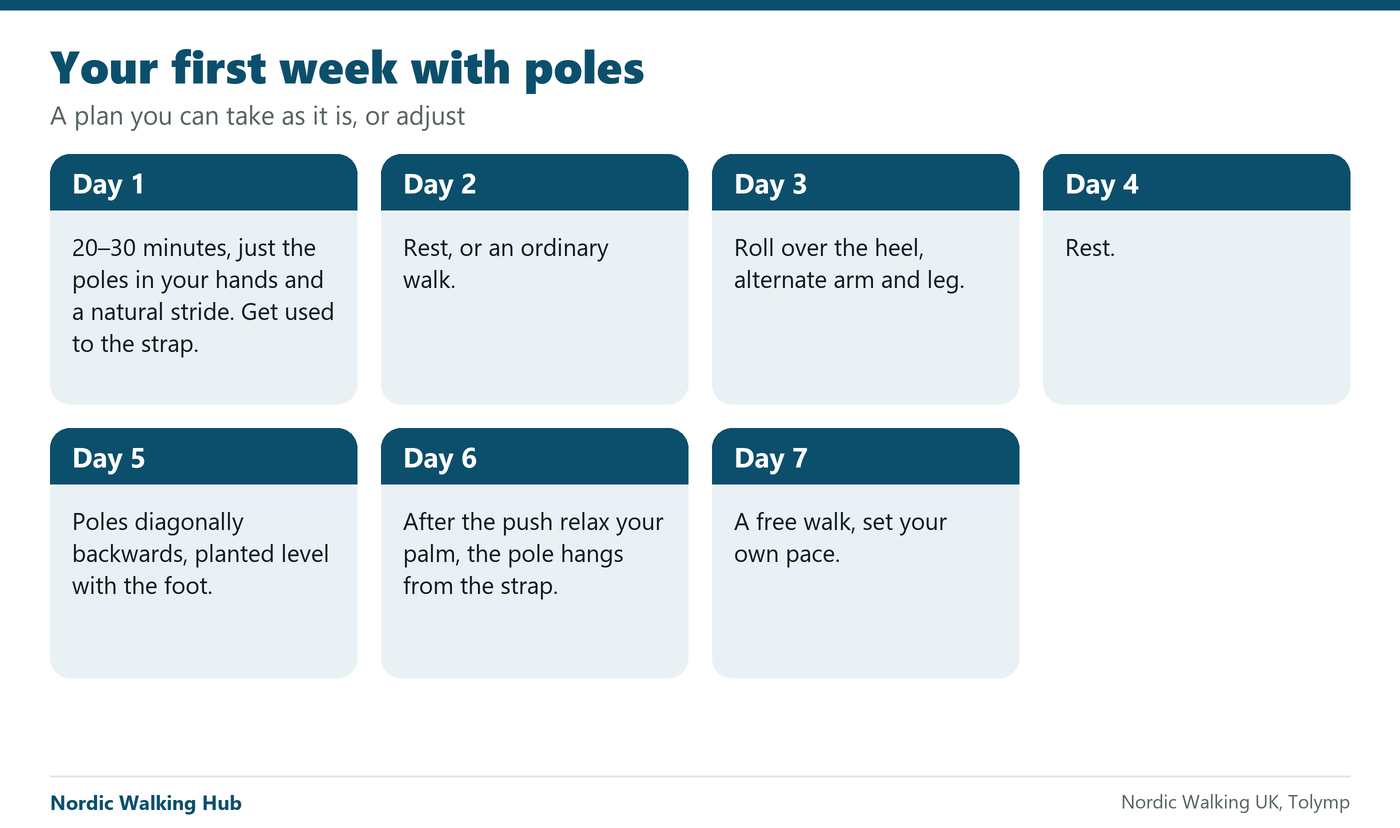
- Day 1: 20–30 minutes, just the poles in your hands and a natural stride. Get used to the strap. Let the poles trail behind you.
- Day 2: rest, or an ordinary walk.
- Day 3: focus on rolling over the heel and alternating arm and leg: right foot forward, left arm forward.
- Day 4: rest.
- Day 5: the poles point diagonally backwards and are planted roughly level with your foot.
- Day 6: once your hand has passed the hip, relax your palm and let the pole hang from the strap.
- Day 7: a free walk, set your own pace.
You do not have to keep to the plan day by day. If one step does not work yet, stay with it a little longer. After a week you will not be a Nordic Walker, but you will see what comes naturally and what needs time.
When something does not work
Three difficulties recur in almost everyone, and each has a simple fix.
- **You walk like a “rower”, the same arm with the same leg.** Walk for a while without planting the poles: let them drag behind you on their straps, and after a while the arm and leg cross naturally, as the body is used to.
- **You plant the pole too far forward.** Plant it at an angle of about 45 degrees between your feet, not in front of you. A pole in front of the body brakes you instead of moving you forward.
- **You grip the pole tightly.** A firm grip belongs to the moment of planting. As soon as your hand passes the hip, open your palm and let the strap hold the pole.
What to expect
The first walks may feel clumsy, and that is fine. Your attention belongs to the coordination of arms and legs, not to speed or distance. Once the alternation comes by itself, speed will follow. Do not compare yourself with people who have walked for years.
With whom and where
If you like company, look for a group near you, or an instructor. In a first lesson the poles are usually adjusted, the alternation of arms and legs is shown and a short route is tried. That is the part people find hardest to learn alone. And someone who goes with others does not give up so easily.
And if the first week only goes half right, that is fine. Start again from day one, the poles are not going anywhere. Nobody is judging how fast you learn Nordic Walking. What matters is that you went outside and moved, and that you enjoyed it, or at least a little.
How did your first week go? Tell us in the forum what came easily and where you got stuck.
Sources
Text: Kompas.
Would you like company on a walk?
Join our group for the Prague-West area and its wider surroundings. We will arrange the pace, routes and first meeting together.

Join the discussion
Members can comment. Log in or create a free account.