


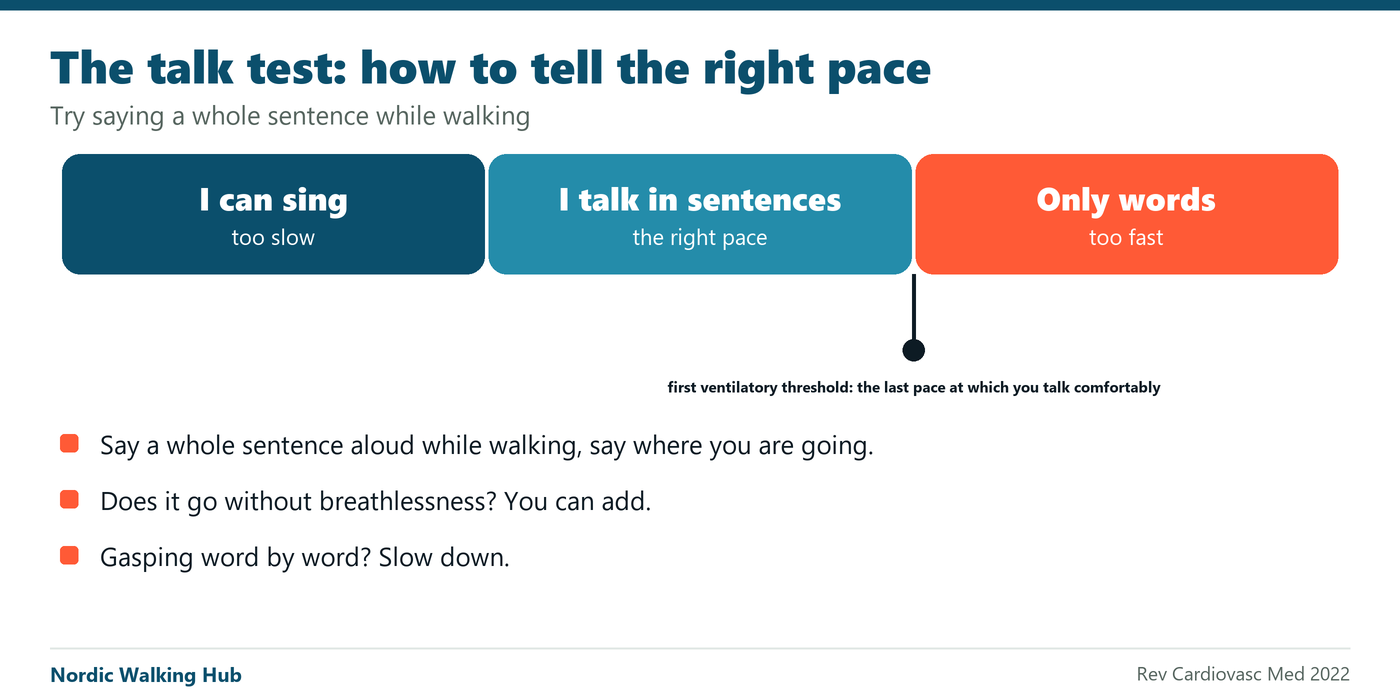
You do not need a watch with a heart-rate monitor to know whether you are walking too slowly or too fast. There is the so-called talk test: try saying a whole sentence while walking. It sounds silly, but there is research behind it, and in our view it is the best pace gauge people have, and it is free besides.

In brief
- While walking try saying a whole sentence. Does it go comfortably? The pace is right.
- The last level of load at which you talk comfortably corresponds to the first ventilatory threshold, the place where breathing starts to speed up.
- Ten studies, 414 people, mostly with heart diseases. The reliability is satisfactory, but it was studied in the laboratory.
- You need no watch or equipment. If you walk in pairs, the pace sets itself.
How it works
The body tells you how hard you are working, you just have to learn to listen. When you walk calmly you speak fluently. When you speed up you begin to breathe more loudly and sentences get shorter. And when you add still more, you cannot say more than a word or two. The talk test turns that into a simple rule: the last pace at which you can still talk comfortably is the right one for endurance exercise.
What research says about it
A systematic review from 2022 included 10 studies in which 414 people, mostly with coronary artery disease, were exercising and talking at the same time. Seven studies were of moderate to high quality. The studies differed in procedure, but all had in common that speech was observed together with load.
- The last level of load at which a person can still talk comfortably corresponded to the first ventilatory threshold. That is the point at which breathing begins to speed up noticeably.
- Power output, oxygen uptake and heart rate at this level were the same as at the threshold.
- The authors rate the reliability of the test as satisfactory, but only one study assessed it properly.
You can imagine the first ventilatory threshold as the place where calm breathing turns into breathing that you can already hear. Up to exactly that moment you can still talk comfortably. And beyond that boundary begins walking that is visible in the breath and in the pulse.
How to use it
The authors suggest as the intensity for endurance exercise the level at which you can still talk comfortably. In practice: if you are walking and can say a sentence without effort, you are fine. If you can only gasp out a word at a time, slow down. You do not have to count or measure anything, it is enough to try saying something longer on the way.
It is good to use it at the start: set out, after a few minutes say aloud where you are going and what happened to you today, and the pace will tune itself. If it goes without breathlessness, you can add. If not, slow down.
If you walk with a friend or in a group, you have the test for free: when you can chat, the pace is good. Whoever is silent because they have no breath is going faster than they should. It is one of the reasons walking in pairs or in a group is more pleasant: the pace sets itself.
What to watch out for
The test was studied mainly in people with heart diseases and in the laboratory, not specifically in Nordic Walking. The exact procedure is not standardised, so the authors recommend interpreting the results with care. As an orientation while walking, though, it works, and it is free. In our view it is the best hint for beginners, because it needs no equipment or knowledge.
How do you talk while walking with poles? Have you tried singing on the way? Tell us in the forum.
Frequently asked questions
**Does it hold when I walk uphill?** Going uphill you get out of breath sooner, so the pace at which you can still talk will be slower. That is fine. The test adapts to the terrain, it does not depend on speed, it depends on how you feel.
**Do I have to talk aloud?** Even quietly is enough, the main thing is a fluent sentence. If you walk with someone, you have the test for free. If alone, try saying aloud what the weather is doing today.
**Is it accurate?** The authors rate the reliability as satisfactory, but only one study assessed it properly. The test was studied mainly in people with heart diseases and in the laboratory. As an orientation while walking, though, it works, and it is free.
**Should I use the test or a heart-rate watch?** They complement each other. The watch shows the pulse, the test shows how you feel. If you are unsure, trust the test more: the body is not wrong as often as an instrument.
When the test misleads
When you go up a steep hill, into the wind or straight after a meal, you get out of breath sooner. The pace at which you can still talk will be slower, and that is right: the test adapts to what the body can manage at the moment. Do not compare yourself with how you walked yesterday on the flat.
Text: Kompas.

Join the discussion
Members can comment. Log in or create a free account.