


We all know “ten thousand steps a day”. It hangs on watches, in apps, on posters in surgeries. But is it a real threshold, or just a round number that is easy to remember? In 2025 a large review of prospective studies was published and the answer is reassuring for most of us. Let me say right away how we see it: you do not have to walk ten thousand to benefit, and that is good news.

What the review did
The authors searched two large databases for ten years, up to February 2025, and chose only studies that followed people forward in time and measured steps with a device, not by estimate. It included 57 studies from 35 groups of people, and 31 studies from 24 groups went into the calculations. They wanted to know how the number of steps relates to mortality, heart and blood vessels, cancer, diabetes, dementia, mental health, physical function and falls.
Where the turning point is
For overall mortality, cardiovascular disease, dementia and falls the relationship to the number of steps flattens as the number grows. The turning point comes roughly between 5,000 and 7,000 steps a day. In other words: you get the most benefit from the first steps, and the more you add, the smaller the benefit. For cancer, diabetes and depression the relationship is more direct: more steps, a somewhat better result.
What happened at 7,000 steps
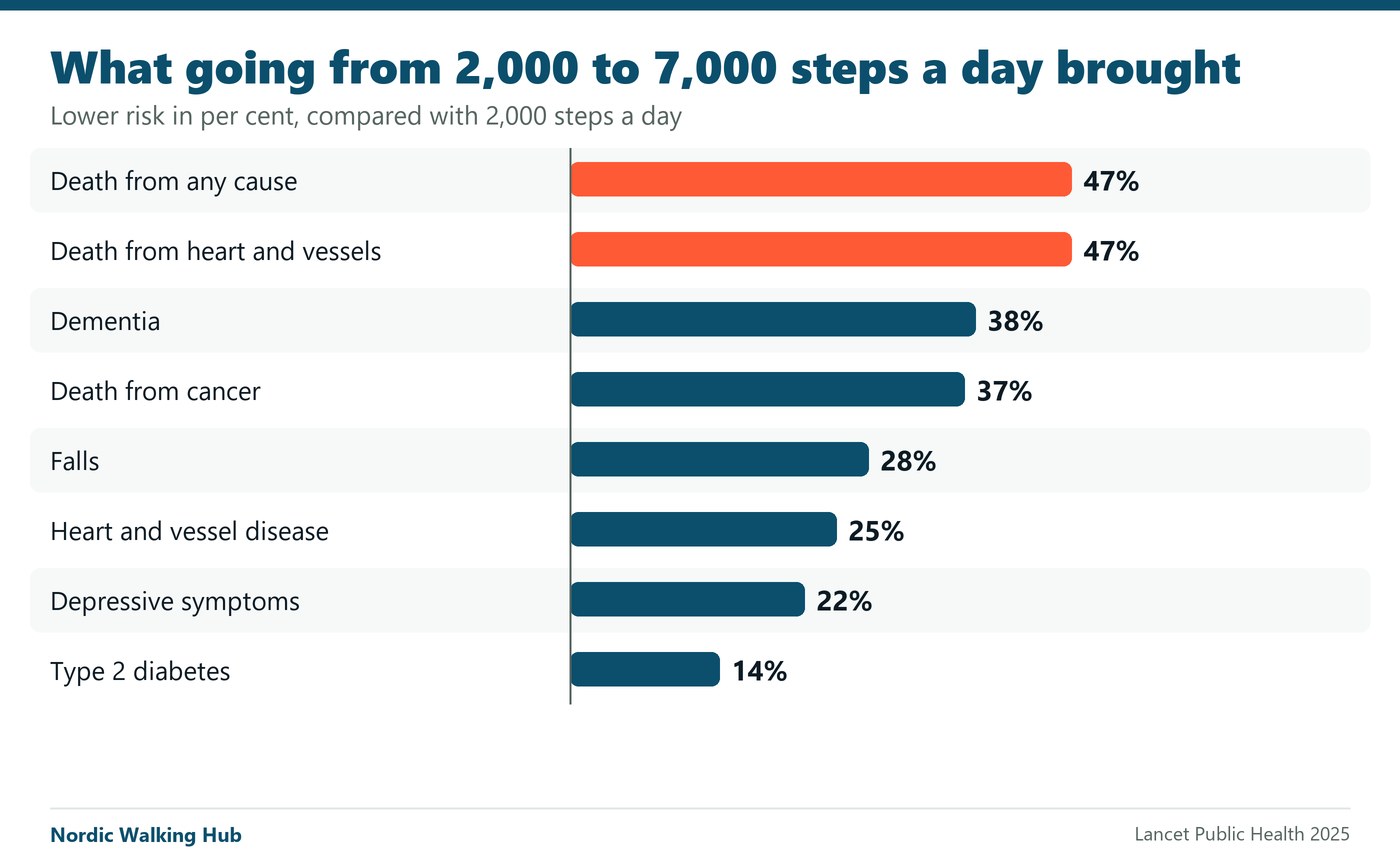
Compared with 2,000 steps a day, 7,000 steps were associated with:
- a 47% lower risk of death from any cause,
- a 25% lower risk of cardiovascular disease,
- a 47% lower risk of death from heart and blood vessels,
- a 38% lower risk of dementia,
- a 22% lower risk of depressive symptoms,
- a 14% lower risk of type 2 diabetes,
- a 37% lower risk of death from cancer,
- a 28% lower risk of falls.
For the onset of cancer only six per cent came out, and that was no longer statistically significant. To be fair, that is here too: not everything improved equally. But the summary is clear.

How to read it
These are observations, not an experiment. People who walk more may also be healthier in other ways, and the authors state this explicitly as a limitation. The certainty of the evidence was moderate for most outcomes, low for death from heart and blood vessels, onset of cancer and physical function, and very low for falls. The numbers do not say that 7,000 steps “arrange” 47% of health. They say that the difference between almost no movement and a reasonable amount is large.
Our reading is this: the 10,000 figure was born of marketing and survived because it is round. The studies show that a good start is much closer. Whoever cannot manage it today should not despair. Whoever manages it can enjoy the bonus.
What it means
The authors write that 10,000 steps remains a good target for more active people, but 7,000 is associated with a meaningful improvement and for some may be more realistic. How many steps a watch counts when walking with poles, the studies do not address. In practice it is known that watches sometimes count too many and sometimes too few, and that it is not worth any nerves.
If you have walked little so far, you do not have to jump to ten thousand at once. Add a thousand steps, say around the block after dinner, and a month later another. That first piece is the most important. And if you already walk, do not despair if one day does not work out. The overall picture counts, not one day.
And one more thought: the steps a watch counts add up over the whole day. A trip to the shop, a walk with the dog, the stairs at work. Nordic Walking is just one of the ways to collect those steps, and a pleasant one at that.
How many steps do you usually walk? Tell us in the forum how many your watch or phone shows and whether the numbers motivate you or rather stress you.
Frequently asked questions
**Are steps with poles counted the same as without?** The review did not address it. In practice it is known that watches sometimes count too many steps and sometimes too few when you walk with poles. Do not let that stress you: the time you spend moving matters more than the exact number.
**How do I know I have enough?** The turning point is around 5,000 to 7,000 steps a day. If you reach that on most days, you are in the band in which the benefit flattens. More steps do no harm, but the gain is smaller.
**A watch is not enough, is it?** A watch is just a tool. The studies followed people with devices, because estimates of “how much I probably walked” tend to be biased. For you they are more useful than for scientists: they give feedback.
**What if I cannot walk that much?** Start with what you can. The difference between 2,000 and 4,000 steps is large according to the review, even though the number sounds modest.

Text: Kompas.

Join the discussion
Members can comment. Log in or create a free account.