

Choosing pole length by arms bent at the elbow makes no sense for ordinary recreational walking. Why? In our experience, a pole chosen this way is often too long for someone with a shorter, natural stride. To finish with the hand and pole behind the hip and allow the trunk to turn, they would have to lengthen their stride considerably and adapt to the pole. Many older people and recreational walkers do not want to or cannot walk that way. The pole then stays in front of the body: instead of pushing off behind them, they simply plant it in front. That is why we do not start with a right angle at the elbow or a height multiplier. We start with your normal stride and a length that lets you push off comfortably, with your hand and pole finishing behind your hip. This is the basis of the Nordic Walking Hub formula and the observations of the Hudrator–Nunaatina study. Pole lengths for a long sporting stride come later, for comparison.
Why we start with your natural stride
What decides it is how you walk with the poles. The Hudrator–Nunaatina study (ten years of observing and checking with tens to hundreds of people aged 35–60, walking at an ordinary pace of 3.5–5.5 km/h) shows two ways. Either you walk with your hands in front of your body and the poles simply "clack" in front of you: your hands and poles do not finish behind your hips, and your trunk does not turn. In our approach, we do not call this walking with support. For a recreational walker, it is an unnatural movement that lacks the push-off behind the body and the trunk involvement we aim for in Nordic Walking. Or you lead the pole behind the body: the hand with the pole ends behind the hip, the trunk has to turn, the push comes from the arm and the trunk, and the pole works as a support that the body pushes off from, forwards. Only that way does the whole body take part, energy expenditure rises and walking is a better experience. According to the Hudrator–Nunaatina study: people who walk like this have a more valuable walk and use more energy than those who clack the poles in front of them.
According to the Hudrator–Nunaatina study, shorter poles are more comfortable. They work as a support when walking uphill and also downhill, much better than poles held in front of the body. With a correctly chosen shorter length, the extent to which the poles are used is 40 to 50% greater than when walking with the poles in front of the body.
Nordic Walking makes sense because it brings the upper half of the body into walking. Studies show this. Walking with poles needs more oxygen than ordinary walking (Sugiyama et al., 2013). In experienced walkers using a vigorous technique, energy expenditure was up to 67% higher than in ordinary walking (Hansen and Smith, 2009). According to the Hudrator–Nunaatina study, pole length should allow a push-off behind the body and a natural trunk turn. With this technique, the oblique and rectus abdominal muscles also take part in the movement. When the hands and poles stay in front of the body, the arms do most of the work and the targeted trunk involvement we aim for is missing. Simply holding poles is not enough: in our approach, Nordic Walking means walking with a push-off behind the body and trunk movement. Zoffoli et al., 2017 also recorded greater abdominal muscle activity during the pole walking they studied; our choice of pole length here comes from the Hudrator–Nunaatina study.
The length of the poles decides whether the second way is possible. Good news from research: regular pole walkers around fifty (average 50.6 years, almost all women) walked with poles 7.5 cm shorter than they had chosen themselves just as comfortably and used 3% more energy uphill (Hansen and Smith, 2009). Shorter poles do not take anything away. That the trunk turns at the right length comes from the Hudrator–Nunaatina study. Longer poles may suit a long sporting stride; an uphill route alone is not a reason to lengthen them. In our approach, the pole should also allow a comfortable plant and push-off uphill without unnaturally raising the hand. Plant the shorter pole into the slope slightly ahead of you. As you step, your body moves past the planting point, your hand guides the pole backwards alongside your body, and the push-off moves you forwards. You should not have to reach high in front of your body simply to plant a long pole on the slope. We adapt the length to the stride and terrain, rather than adapting the arm to the pole length.
Examples from the Hudrator–Nunaatina study
- Man, 196 cm, less athletic build: poles of 105 cm. By the misleading bent-elbow formula (height × 0.68) he would have 133 cm.
- Woman, 176 cm, slim athletic build, physically fit: poles of 102 cm. By the misleading bent-elbow formula she would have 120 cm.
- Woman, 173 cm, slim athletic build, lower hips (shorter legs): poles of 97 cm. By the misleading bent-elbow formula she would have 118 cm.
In all three the trunk turns when pushing off and the hand with the pole ends behind the body. The Nordic Walking Hub formula for pole length is based on these cases.
Which poles: three-section poles with lever locks
For walking with a backpack, up hills and to the views, we recommend three-section adjustable poles with lever locks. They pack smallest, are the easiest to carry and to stow in a backpack, and their length is the quickest to set. They suit beginners, groups and travel.
A practical tip that has worked well for us: once you have checked your length while walking, mark the extension sections of your poles with a marker at the setting points. After folding the poles, you can quickly restore the right length using the marks. The marks record your length; always secure the lever locks before walking.
We do not recommend twist-lock telescopic poles. According to the Hudrator–Nunaatina study, twist locks do not hold and the pole collapses under load.
One-piece fixed poles are for athletes. For walking with a backpack in the hills they bring no advantage and are harder to carry.
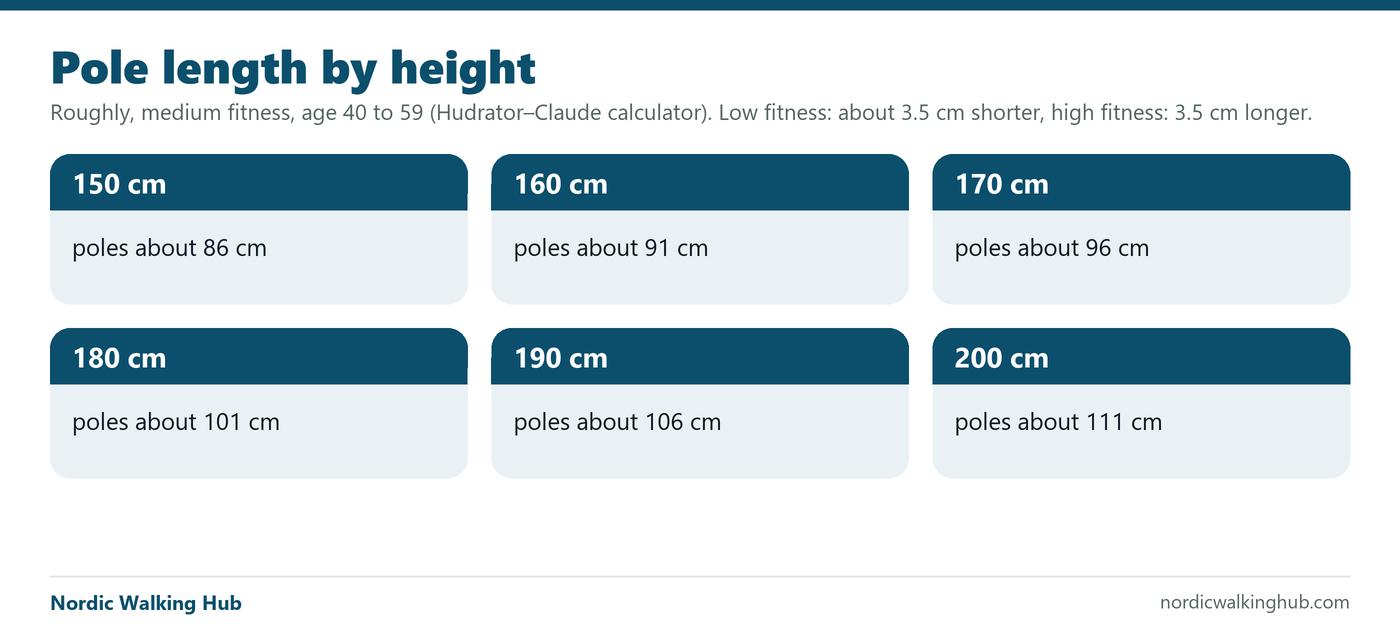
The Nordic Walking Hub formula is based on the long-term Hudrator–Nunaatina study. It calculates pole length for a comfortable push-off, with the hand and pole finishing behind the hip.
How to check
- Walk normally with the poles trailing behind you and push off alternately.
- The trunk should start turning by itself and the hand with the pole ends behind the hip.
- If you clack the poles in front of you, they are too long: shorten by 5 cm. If you cannot push off comfortably, they are too short: lengthen by 5 cm.
How to find your length
- Starting setting: the pole reaches roughly to the hip (from the floor to the hip bone), a few centimetres higher for fitter people. So pole length is linked to leg length.
- First walk normally, without poles, at your own pace.
- Take poles that are shorter rather than longer than you expect, and clearly shorter than the bent-elbow rule gives. Let the poles trail behind your body as if you were dragging them.
- Push off alternately. As soon as the trunk starts to turn by itself and the hand with the pole ends behind the body, the length is good.
- If you "clack" the poles in front of you and the trunk does not turn, they are too long. Shorten them by 5 cm and try again.
- Uphill, check that you can plant the pole comfortably without raising your hand high. If the length forces an unnatural position, shorten it by 5 cm and try again. Try a longer setting only when it suits your actual long sporting stride, always in steps of 5 cm.
Work out your length with the Nordic Walking Hub formula: pole length calculator. That is why we recommend adjustable poles, at least to try out. The method comes from the Hudrator–Nunaatina study, supported by the other studies above.
The bent-elbow rule is not for Nordic Walking, but rather for Nordic running
Body height × 0.68, rounded to the nearest 5 cm. This formula, which is based on the bent elbow, we call the misleading bent-elbow formula. A person 172 cm tall: 172 × 0.68 = 117 cm, so poles of 115 cm. You will find this advice almost everywhere.
Blindly setting the pole length by the bent elbow (a right angle when you stand the pole upright beside you) may suit skiing, but not Nordic Walking. With that length the pole stays in front of the body, the walker walks with the hands in front of the body, the poles do not finish behind the hips, and the trunk does not turn. On an average build the elbow is at about 63% of the height and the hip at about 53%: for a person 175 cm tall that is a difference of roughly 17 cm.
Why the misleading formula does not fit
- It only takes height into account. In the Hudrator–Nunaatina study, age, physical fitness, stride length and build (length of arms and legs, width of shoulders) matter just as much.
- It leads to poles that are too long. With long poles the pole stays in front of the body and the walker just "clacks" them in front of himself or herself. The hands and poles stay in front of the body; the push-off behind the body and the trunk turn are missing.
- It is tuned for a long, sporty stride. For people who walk at an ordinary pace (and this portal is for them) it does not fit.
Sources
- Nordic Walking UK: What Length Nordic Walking Poles Do I Really Need?
- Bristol Nordic Walking: What is the right pole height?
- WALX: Which Type of Nordic Walking Pole Should I Use? (adjustable vs fixed)
- SportMedBC: Nordic Walking Technique and Equipment
Results of the Hudrator–Nunaatina study, backed by other studies. We list the formula and its sources for comparison.

Join the discussion
Members can comment. Log in or create a free account.