
Advertisement
Nordic Walking Hub
Find walking companions
Menu

Author: Hudrator

  • Who walks with poles? Numbers from an international study

    Who actually walks with poles, and why? It is tempting to guess, but there are numbers too. The best current data come from a study published in Scientific Reports in 2025. 760 walkers from Poland and other countries took part. They were volunteers who filled in a questionnaire, so the picture applies mainly to people who wanted to have their say.
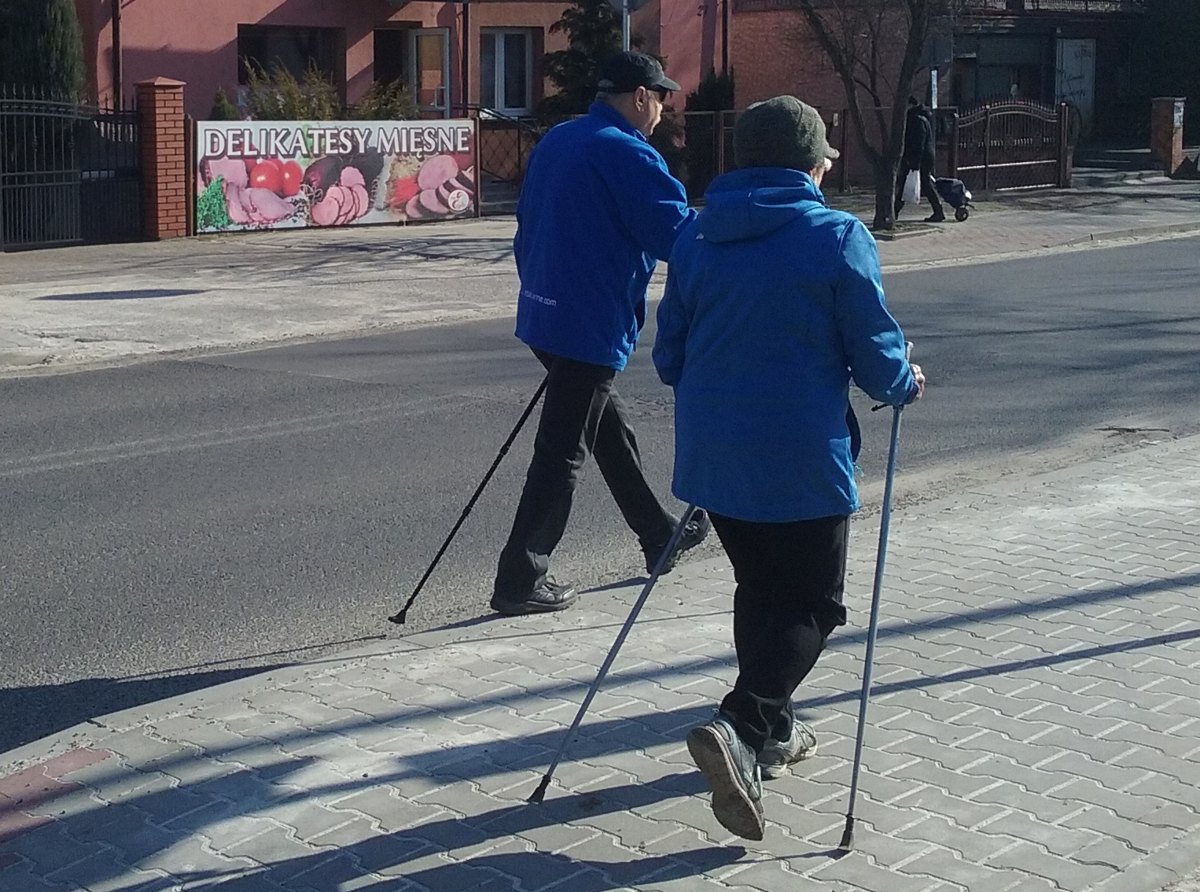
    Photo from the trail

    Who walks

    • the average age is 55 (range 18–94),
    • 75% are women,
    • 76% have a university education,
    • 80% live in a city,
    • 78% walk all year round.

    In other words: the typical walker is a woman of about fifty-five, from the city, educated and persistent. Not a winter athlete, not a competitor, but a person who walks for pleasure and all year round. This is exactly the reader we mainly write for.

    Why they walk

    People rate the good feeling after exercise and regular exercise for health highest, both 4.1 out of 5. Competing came last, rated 2.4 out of 5. Most walkers therefore do not walk for performance but for how they feel afterwards.

    Who they walk with

    Thirty-six per cent walk with an instructor or in a group, 32% with friends and 32% alone. Two thirds of people therefore walk with someone. Walking with poles is for many people also a way to meet others.

    What we take from this

    That is why we build the portal on health, wellbeing and company, not on performance. No rankings and no competing. And if you walk alone, you are not in the minority just by the numbers: a third of people walk alone. But if you are looking for company, look in the group directory.

    Do you walk with poles? Tell us in the forum how you are doing: who you walk with and what brought you to it.

    The age range in the whole study is from 18 to 94. Nordic Walking is therefore not a matter for one generation. But the average of 55 shows that most walkers are in the middle of life. And the fact that 78% walk all year round means that poles are not just a weekend pastime on holiday but a regular part of the week. If you have only just started, you are in good company.

    One more detail from the numbers: 80% of walkers live in a city. Nordic Walking is therefore not a sport for mountain people. It can be done in city parks, along embankments and on the edge of an estate. You just take the poles and step out of the house, no trip to the mountains needed.
    Photo from the trail

    What to take away

    The numbers from the international study show who really walks with poles, and also how different those people are. You are neither too old nor too young for it, and you need not fit any box. An average is just an average: it does not describe you until you join in yourself.

    Do you recognise yourself in the numbers, or are you an exception? Tell us in the forum how old you are and how long you have been walking.

    Sources

    Text: Kompas.
  • What Nordic Walking does to your stride: numbers from 42 studies

    Poles are not just “something in your hand”. They change how we walk: a longer stride, a different rhythm, a different use of muscles. But by how much? A 2020 review pooled the numbers from more than forty studies, so we do not have to guess. And the result is more interesting than you might expect, because it is not only how fast you walk that changes, but also how the body moves while walking.

    Photo from the trail

    In brief

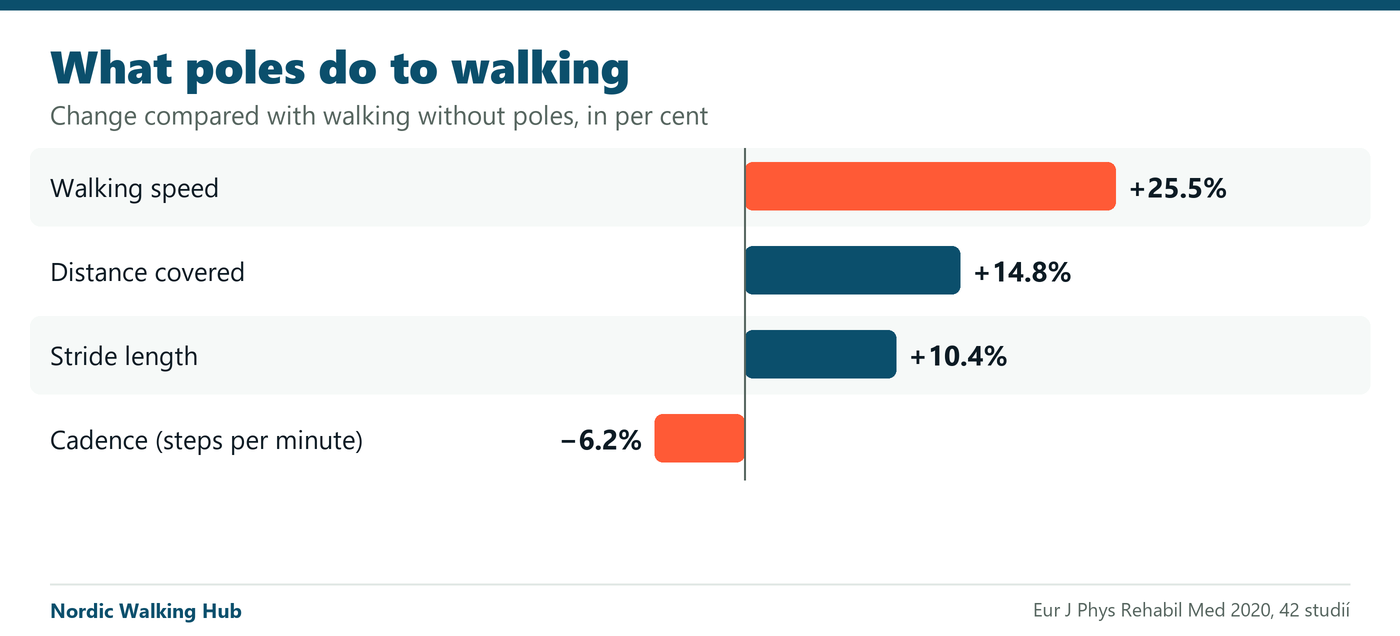
    • Review of 42 studies: with poles the distance covered is 14.8% greater, speed 25.5% higher and stride 10.4% longer, cadence 6.2% lower.
    • The muscles of the upper half of the body work more and the range of motion in the joints grows.
    • Ground reaction force at footfall does not fall, it rather rises: poles do not automatically spare the legs.
    • The numbers are averages. They depend on technique, yours will be different.

    What the review did

    The authors searched databases from October 2008 to October 2018 and selected 42 studies. Their average quality was 5.5 out of 10 points on the PEDro scale, a common scale for rating the quality of clinical studies. They wanted to know what poles do to speed and distance, to muscle activity, to the stride, to movement in the joints and to how hard you step on the ground.

    What it found

    Compared with walking without poles:

    • the distance covered was greater by 14.8%,
    • walking speed was greater by 25.5%,
    • stride length was greater by 10.4%,
    • cadence, that is the number of steps per minute, was lower by 6.2%.

    In addition, muscle activation and strength of the upper limbs, the range of motion of the upper and lower limbs and the ground reaction force increased, the force with which the ground pushes you back at every footfall.

    Chart
    Photo from the trail

    How to read it

    A longer stride at a lower cadence is exactly what you would expect from pushing off with poles: you push off, send the body further and do not have to shuffle as much. That is why you go faster and cover more, even though you take fewer steps per minute. Speed even came out a quarter greater, which is a decent number for a single small thing, poles in your hands.

    To give you an idea of what the percentages mean: 14.8% of five kilometres is roughly 740 metres. And 25.5% more speed means that if you walk four kilometres an hour without poles, with poles you might walk roughly a kilometre an hour faster. These are averages from studies, your numbers will differ, but the order of magnitude is easy to see.

    A cadence lower by 6.2% does not mean you are walking lazily. The steps are longer, so you need fewer of them for the same distance, and when walking with poles the body moves further with each push.

    What the upper half of the body does

    The muscles of the arms, shoulders and trunk work more, and above all they have something to do: the poles push off through them. The authors describe greater activation and strength of the upper limbs and a greater range of motion in the joints of the arms and legs. That is the difference from ordinary walking: it is not only about the legs, it is about the whole body. It also explains why you feel different after Nordic Walking than after a stroll: sometimes the next day it is your shoulders that ache, not your calves.

    An interesting point about the knees

    The increased ground reaction force is interesting. It is not true that poles automatically reduce the load on the legs. In the article about knees we showed that the evidence is mixed, and this number confirms it: with poles you go faster, and the legs may therefore feel a greater force at each footfall.

    What we do not know yet

    The average quality of the studies was only moderate, and the numbers depend on technique. Someone who walks with poles correctly will have a different number from someone who only holds them. Nobody can tell you the exact number for you, but the direction is clear. The authors conclude that Nordic Walking has beneficial effects on many biomechanical parameters and may be an effective way of moving that suits rehabilitation and everyday life.

    Do you notice a difference in your stride with and without poles? Tell us in the forum what yours is.

    Frequently asked questions

    **How do I know I am using the poles correctly?** If you push off, the hand reaches behind the hip, the pole points diagonally backwards and you feel it helping you forward, you are on the right track. The simplest thing is to have yourself filmed from the side.

    **Why do my shoulders ache the next day?** Because the upper half of the body works, which it does not in ordinary walking. The ache should not be sharp. If it is just like after a day’s work, that is good news.

    **Is faster walking with poles better for health?** Whoever walks faster uses more energy, and that is useful. But speed is not the goal. The review says that poles change the movement, not that faster walking is better.

    **Does it save breath, or does it exhaust me?** Both, depending on pace. At a calm walk the difference fades, at a brisk one it grows. That is why the talk test is good: choose the pace at which you can still talk comfortably.

    Photo from the trail

    Text: Kompas.

  • Diabetes and Nordic Walking: small but measurable changes

    People with diabetes or prediabetes know their numbers from check-ups: sugar, cholesterol, weight. Does Nordic Walking move them? A fresh review from 2026 tried to answer, and the result is sober, but not useless.

    Photo from the trail

    What the 2026 review found

    The authors pooled six randomised studies with 321 adults. Compared with control, Nordic Walking brought:

    • a weight drop of 0.79 kg,
    • a drop in glycated haemoglobin HbA1c of 0.37 percentage points (0.49 for diabetes, 0.2 for prediabetes),
    • higher HDL (“good”) cholesterol by 0.07 mmol/l,
    • better maximal oxygen uptake, that is fitness.

    HbA1c is a marker that tells you how high the blood sugar was on average over roughly the last three months. That is why it is followed in diabetes: it does not show only what you ate this morning but the overall picture.

    Fasting glucose, insulin resistance, total cholesterol, triglycerides, LDL cholesterol and blood pressure did not change.

    How to read it

    The changes are small, and for HbA1c the studies differ a lot, with heterogeneity of 69%. That means one study showed a large drop and another almost none, and the combined number is their average. Six studies are also few. It is not a miracle but a small, measurable move in the right direction.

    It is good to know what to expect. If someone promises that Nordic Walking will “fix diabetes”, they have exaggerated. If someone says it is a waste of time, they have exaggerated as well.

    What we do not know yet

    We do not know whether Nordic Walking is better than walking of the same length without poles. The review did not compare them. So the poles may not be what improves the numbers; perhaps it is enough that a person moves regularly.

    Do you walk with poles and follow your values? Tell us in the forum whether you have noticed any changes.

    A weight drop of 0.79 kg is a little less than one kilogram. No revolution, but working with weight is done in small steps, not big leaps. And the fact that fitness improved is good news in itself: better fitness means walking will be easier for you next time too.

    So: a small number, but in the right direction. If you already walk, do not stop. If you do not, poles will not spoil anything, and a few months of regular movement will show not only in the check-up but in how you feel.

    Photo from the trail

    What to take away

    In diabetes the studies agree on small but measurable changes. Small does not mean useless: regular movement adds up over weeks and months. More important than a perfect pace is that you walk repeatedly and without stress.

    Do you walk with poles because of diabetes, or for something else? Tell us in the forum what helps you keep going.

    Sources

    Text: Kompas.

  • Hip, osteoarthritis and poles: what eight studies showed

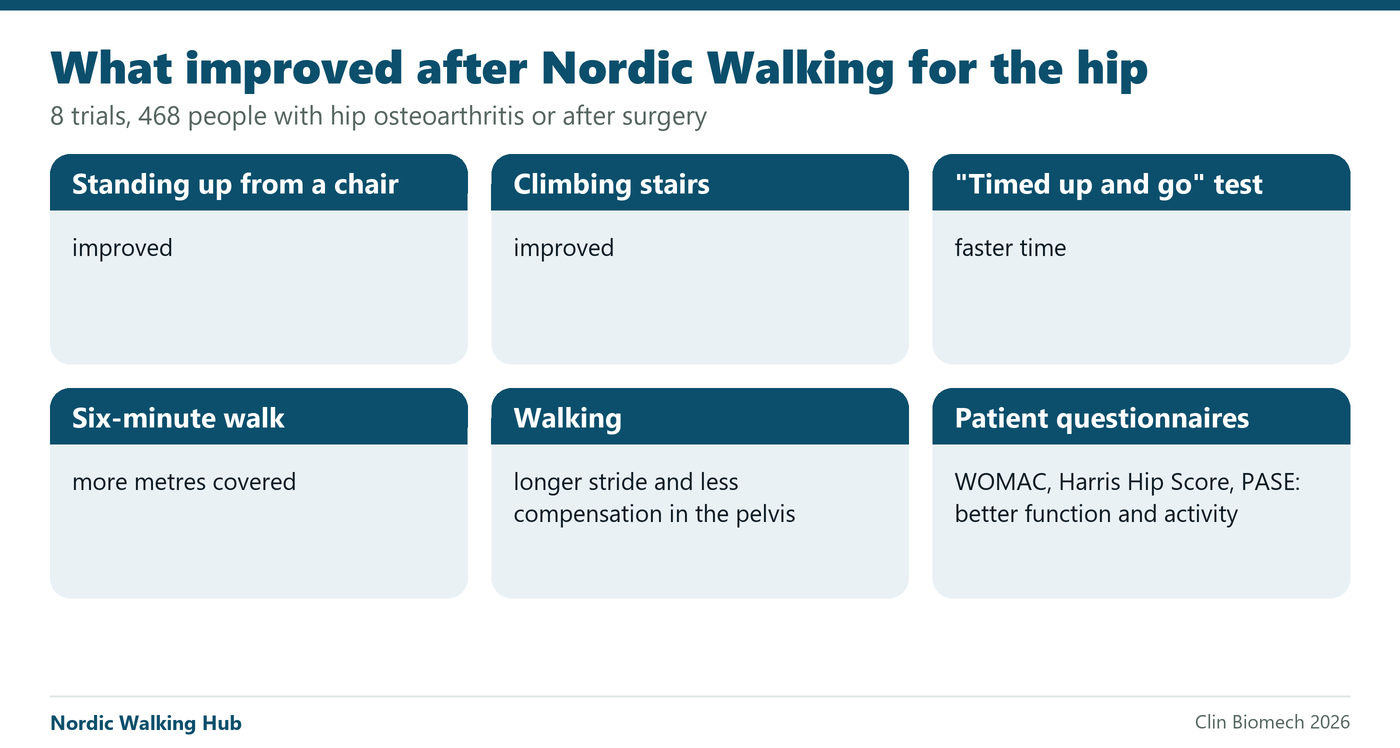
    Hip osteoarthritis hurts and limits movement. An operation, a hip replacement, removes the pain, but weakness in movement can remain for months: a person cannot stand up from a chair properly, fears stairs and walks carefully. Does it occur to you that poles might help? Researchers wondered about that too, and eight trials with 468 people give a fairly clear answer.

    Photo from the trail

    What the review did

    It is a scoping review from 2026. The authors searched seven databases from 2000 to February 2026 for trials in adults who have hip osteoarthritis or have had a hip replacement. They selected eight randomised trials with 468 participants. Quality was moderate to good, the weak spot was blinding: people of course knew whether they were walking with poles or not.

    A scoping review maps what has already been studied and shows the gaps. It does not look for one combined number like a meta-analysis, so it shows a direction, not the exact size of an effect. The direction here is good, but do not expect from it the exact number of how much poles help.

    What was measured and what improved

    The authors followed two groups of outcomes. The first are performances that can be measured with a stopwatch and a tape measure:

    • standing up from a chair,
    • climbing stairs,
    • the “timed up and go” test, in which a person stands up from a chair, walks a few metres, turns and sits down again, and the time is measured,
    • the six-minute walk, that is how many metres a person covers in six minutes.

    All four improved after Nordic Walking. The second group are questionnaires filled in by the patients themselves. They include WOMAC, which asks about pain, stiffness and everyday activities, the Harris Hip Score and PASE, which finds out how active a person is. Here too the results improved, mainly in physical function and in activity.

    Chart
    Photo from the trail

    How walking changed

    What changed in the walking itself is interesting: the stride lengthened and the pelvis “twisted” less. The latter means that the body compensates less for the sore joint with movements that do not belong to walking. A person with a sore hip often limps and sways to spare the joint. With poles you have support, and the body can straighten up.

    These are exactly the things a person with a sore hip needs: to stand up, climb stairs, cover some ground and not walk oddly. Improvement in the tests and in the questionnaires coincide, and that is a good sign. The number on paper and the feeling in life go in the same direction.

    What about after surgery

    For those who already have an artificial hip, the news is more cautious. After hip replacement only one study looked at movement with poles. According to it it is safe and does not load the hip more. But one study is not enough. The authors ask for further quality research before it can be said how and when to start with poles after surgery. Until then it is an open question, not a guide.

    That does not mean you should not try poles after surgery. It means that timing and pace are decided by the people who guide you, not by this review. Follow their advice and do not push the pace.

    What it means

    The review shows that poles are worth studying further for the hip, and that it already makes sense to try them for osteoarthritis. If your hip hurts but has not been operated, these are studies that suggest a benefit for function and for how you feel. The hip is a joint that has no chance of returning to its former strength without movement. Poles offer movement that is smooth and does not fall apart on stairs and kerbs, and that is exactly the kind of confidence a person looks for after surgery.

    Do you have experience with poles for hip osteoarthritis or after surgery? Tell us in the forum how you started and what helped. Such stories are read by people who are standing before that same decision right now.

    Frequently asked questions

    **I have hip osteoarthritis. Should I avoid poles so I do not overload the joint?** The review shows rather the opposite: in eight trials both function and walking improved in people with osteoarthritis. It does not say, however, that everybody should start at once. Begin with short walks at an easy pace and watch how the hip reacts.

    **When should I start with poles after surgery?** The review cannot say. After joint replacement only one study examined poles. Poles are not a replacement for rehabilitation, but they can be an addition to it. Timing and pace follow how the hip is healing.

    **Do poles improve pain?** The review assessed function and activity, not pain separately. The WOMAC questionnaires also ask about pain, and those improved, but from the summary one cannot tell how much of that is due to the poles. Regularity is decisive.

    **How strong do I have to be?** You do not need any special training. The studies followed ordinary people with osteoarthritis or after surgery, not athletes.

    Photo from the trail

    Text: Kompas.

  • Nordic Walking after breast cancer: what the reviews say and what to watch out for

    After breast cancer treatment, gentle movement for the whole body is helpful, and poles engage the shoulders and back too, the places that often stay stiff after surgery and radiotherapy. What is known about Nordic Walking after breast cancer? Two reviews, one from 2019 and one from 2026, give a fairly concrete answer: it helps, but the studies are small, which is why it is good to hold off on big promises.

    Photo from the trail

    In brief

    • Two reviews, 2019 and 2026, with dozens of studies in total on women after breast cancer.
    • Improvement in fitness, range of motion in the shoulder, posture and in some studies also lymphoedema, pain and psychological wellbeing.
    • The studies are small and of varying quality, but the results point in the same direction.
    • Begin with short walks at an easy pace and do not force the arm into anything that hurts.

    Why poles

    After breast cancer treatment women often struggle with long-term physical and psychological difficulties that affect quality of life. Exercise-based rehabilitation is increasingly recommended for them. Walking with poles fits in: it engages the arms and trunk, opens the chest and keeps the body upright, and it is a smooth movement outdoors, not a workout in a gym.

    The 2019 review

    It included nine studies, four randomised and five without random allocation. According to the authors, Nordic Walking had a positive effect on a number of complaints, including lymphoedema, that is swelling of the arm, as well as fitness and the feeling of disability. Nobody reported adverse effects. The quality of the studies was average to weak, which is why the authors ask for further research.

    The 2026 review

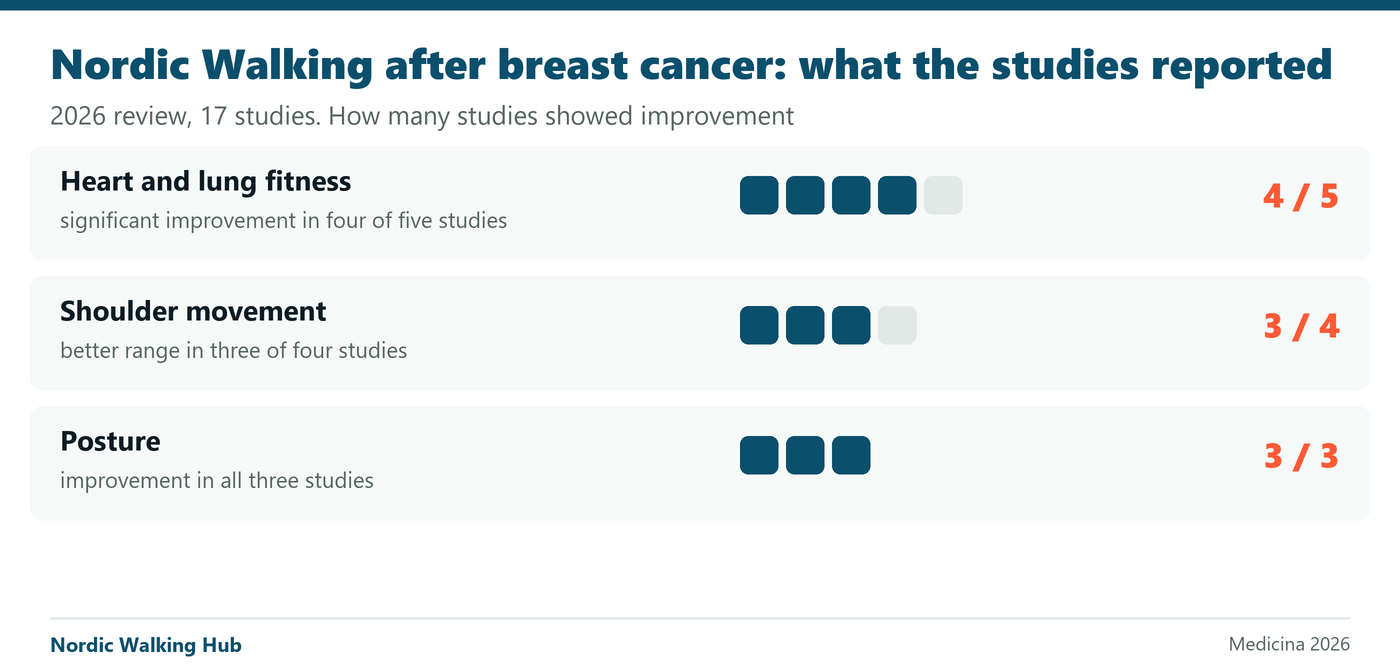
    It is newer and larger. The authors searched six databases from their beginnings to the end of 2025, with no language restriction, and from 281 records found selected 17 studies. They covered Nordic Walking alone and in combination with other exercise. The authors report:

    • improved heart and lung fitness in five studies (significant in four of them),
    • better range of motion in the shoulder in three of four studies, mainly after stand-alone Nordic Walking,
    • better posture in all three studies that followed it,
    • improved strength in five studies and flexibility in one,
    • lasting reduction of lymphoedema mainly after programmes lasting several weeks, especially in combination with the ISA method, in seven studies that assessed lymphoedema,
    • improvement in pain, psychological wellbeing and quality of life in several studies.
    Chart
    Photo from the trail

    How to read it

    These are small studies of varying quality. The 2026 review describes what each study found, not certainty. In other words: the results go in the same direction, but there is not yet enough firm evidence to promise anything. The authors nevertheless conclude that Nordic Walking appears to be an effective, holistic form of exercise that helps in both physical and psychological respects.

    What it means

    What recurs most in the reviews is posture, range of motion in the shoulder and fitness. Those are things that walking with poles engages naturally, so it is logical. From that a simple start can be drawn: short walks at an easy pace, holding the poles loosely and keeping the shoulders relaxed. If the arm hurts after surgery or radiotherapy, adjust the pace and the length of the walk. Nobody is chasing you.

    It is just as logical to start slowly and not to force the arm into anything that hurts. With lymphoedema one important thing appears in the review: lasting reduction is mentioned mainly after programmes that lasted several weeks. So do not expect a change after one walk, count on weeks.

    Do you have experience with Nordic Walking after breast cancer treatment? Tell us in the forum how you started and what helped. Such experiences are read by women who are standing before that same question right now, and for them every story is precious.

    Frequently asked questions

    **When should I start after treatment?** The reviews describe programmes lasting several weeks, at an easy pace, mostly led. Begin with short walks and watch how the arm reacts.

    **Will it help with arm swelling?** The 2026 review reports lasting reduction of lymphoedema, mainly after programmes lasting several weeks and in combination with the ISA method. No change is expected from individual walks. Count on weeks.

    **Is it better to do Nordic Walking alone or with other exercise?** The review included both. Range of motion in the shoulder improved mainly after stand-alone Nordic Walking, flexibility and strength rather in combined programmes. Both make sense.

    **Is it only physical, or psychological too?** Several studies reported better psychological wellbeing and quality of life. Movement outdoors, in a group and at an easy pace is often as important for the head as for the body.

    Photo from the trail

    Text: Kompas.

  • Chronic pain and fatigue: it helps, but not always more than ordinary walking

    People with long-term pain or fatigue look for movement that will not hurt them. Movement is needed, but when your whole body hurts or you are exhausted in the morning, you do not feel like doing anything. And you fear that exercise will make everything worse. What does a 2024 review say about Nordic Walking? It is reassuring reading, at least for those who want to get moving.

    Photo from the trail

    In brief

    • Review of 14 studies, 20 to 136 people, programmes of 6 to 24 weeks, 2 to 4 days a week, 25 to 75 minutes.
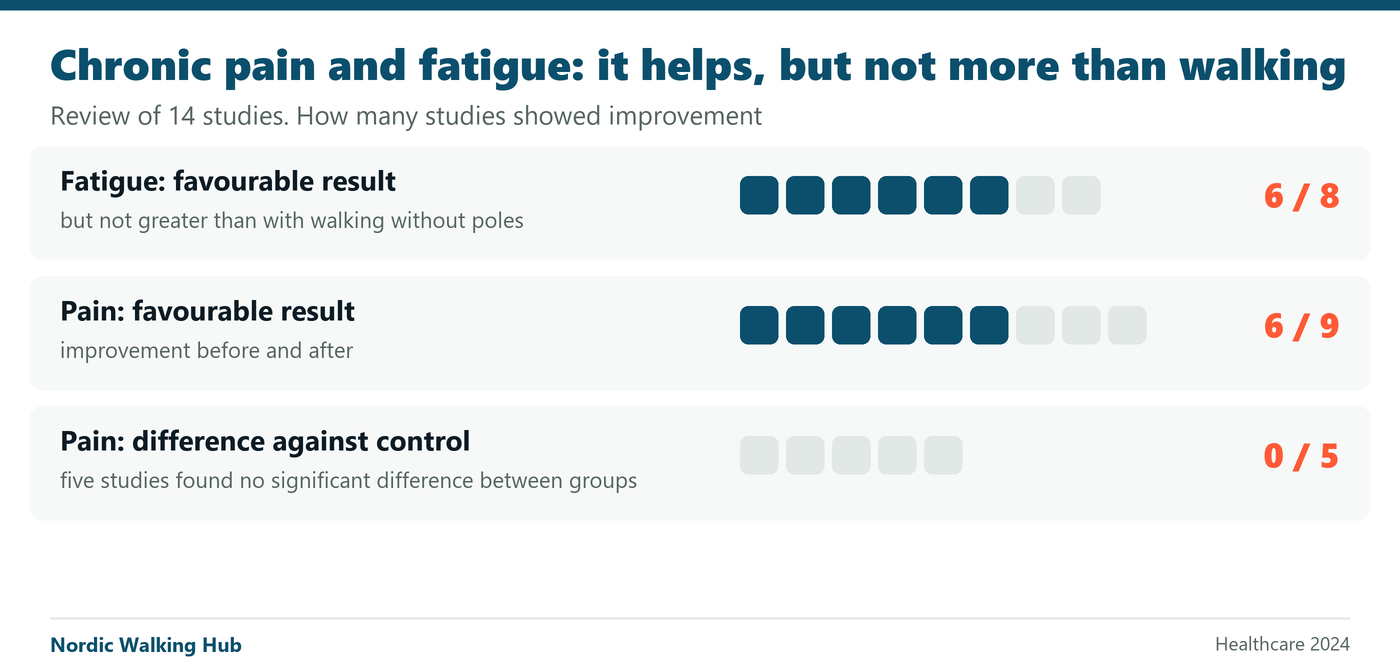
    • Fatigue improved in 6 of 8 studies, pain in 6 of 9. Against control or against walking without poles, though, the improvement was not greater.
    • Poles are not a magic pill. What helps is regular movement and that you stick with it.
    • It is easy to learn and is led in a group, which helps persistence.

    What the review did

    The authors searched five databases and chose randomised trials in which Nordic Walking was tried for pain and fatigue. They found 14 studies, with 20 to 136 participants. Quality was fair in five studies and good in nine. The programmes were led: it was supervised Nordic Walking lasting 6 to 24 weeks, two to four days a week, for 25 to 75 minutes.

    What it found

    • Fatigue: 6 of 8 studies had a favourable result. Compared with ordinary walking (2 studies) or with no activity (1 study), though, it was not greater.
    • Pain: 6 of 9 studies had a favourable result. Five studies that compared groups with each other, however, found no significant difference.

    In other words: most people felt relief after the programme, but so did those who walked without poles or did nothing special. So poles on their own are not a magic pill.

    Chart
    Photo from the trail

    How to read it

    Improvement “before and after” does not mean that Nordic Walking in particular is responsible for it. People might improve on their own, or thanks to regular movement in general. The authors nevertheless write that it is a potentially effective method and that it is easy to learn, which may increase persistence. And persistence is the key with chronic pain: movement helps mainly those who stick with it.

    Besides, improvement in people with chronic complaints is often not only about numbers on a pain scale. It is about going out again, someone smiling at you and having a plan for tomorrow. That is not counted in studies, but we are convinced that it plays a role.

    What we do not know yet

    We do not know whether it is better for pain than ordinary walking. The studies were mostly not large, and people with chronic pain are very different. What relieves one may not relieve another.

    So if you enjoy poles, try them. If not, ordinary walking will probably do a similar service. What matters is that you move in a way that does not put you off.

    If you want to run your own experiment, the studies give a reasonable frame: two to four days a week, 25 to 75 minutes, at least six weeks. Write in a calendar how you feel, even just a number from one to ten, and after six weeks compare the first and the last week. Numbers in a calendar are more honest than memory.

    And one more thought: with chronic pain it is often about giving the body back the confidence that movement is not dangerous. A slow pace, poles in your hands and a walk outdoors can be a good first step.

    Do you suffer from long-term pain or fatigue? Tell us in the forum what helps you. We will all learn from each other.

    Frequently asked questions

    **Will exercise make my pain worse?** The review reports no worsening. Most studies showed improvement. That does not mean you should not start slowly, though. A slow pace and short walks are a better start than a long day after which you cannot move.

    **Should I walk even on a day when it hurts more?** That is up to you. The studies had a programme of two to four days a week, so rest days bothered nobody. Listen to your body, but do not let the pain decide everything.

    **Should I exercise alone or in a group?** The programmes in the studies were led, that is in a group. Company helps you persist. If you have no group, a friend is enough.

    **How do I know it is helping?** Try writing in a calendar a number from one to ten for how you feel. After six weeks compare the first and the last week. Numbers in a calendar are more honest than memory.

    Why a “group” helps

    The programmes in the studies were led and took place in a group, and that is probably no accident. People with chronic pain and fatigue easily withdraw into their homes. When someone is waiting for you at the stop, you get up even on a day when you do not feel like it. If you are looking for a group near you, see the group directory. And if there is nobody there, try writing in the forum: perhaps someone will respond.

    Photo from the trail

    Text: Kompas.

  • Parkinson’s and Nordic Walking: what the studies actually showed

    With Parkinson’s disease Nordic Walking is often named as a suitable exercise. Poles give stability and encourage longer steps, and that sounds like exactly what this disease needs. But what does a 2022 meta-analysis of randomised studies say?

    Photo from the trail

    What the review found

    It included 12 randomised studies, mostly of good to satisfactory quality. Conclusions:

    • Nordic Walking did not lead to a clinically significant change in overall motor symptoms, functional mobility, balance or fitness.
    • Walking ability improved and probably quality of life too. For the latter the authors say that further research is needed.
    • People kept to the programmes well, but some also reported adverse effects.

    How to read it

    “Statistically significant” does not mean that a person will notice it. There can be a difference that can be measured but does not show in everyday life. The authors write that apart from walking ability none of the significant results was clinically significant. That is why we do not claim that Nordic Walking “treats” Parkinson’s disease or that it improves balance. The studies showed nothing of the kind.

    It is interesting that people kept to the programmes well. With a disease that takes away appetite and energy, that is not a given, and it is a good reason to try poles.

    What it means

    Better walking and a reason to walk outdoors regularly is valuable in itself. Parkinson’s disease takes confidence away, and when you improve your walking and have a group or a regular meeting for it, you get more than any number will show. But that is not counted in studies, and that is why it is not visible in the results.

    The adverse effects that some reported are a reminder that it is good to start slowly and not get carried away. With poles or without.

    Do you walk with poles with Parkinson’s disease? Tell us in the forum what it is like. More than studies, we are interested in your story.

    A clinically significant difference is one that a person recognises in everyday life: they stand up more easily, stumble less, manage more in a day. A statistically significant difference can be tiny and not show in daily life. That is why the distinction matters, and why it is good that the authors do not overlook it.

    If you are thinking about poles with Parkinson’s disease, the first lessons with someone who has already met the disease are useful, say a physiotherapist or an instructor with experience. They know how to adapt walking with poles so that it helps you and does not tire you.

    Photo from the trail
    Sources

    Text: Kompas.

  • Does Nordic Walking help thinking? One ability yes, others not yet

    It is often said that walking “clears your head”. It sounds like a saying, but scientists have actually looked into it, also for Nordic Walking. What did they find? Something yes, something no, and that is exactly what is interesting.

    Photo from the trail

    What the 2025 meta-analysis found

    The authors pooled 8 studies from 2014 to 2024 with 327 participants, average age about 71.

    • Executive functions, that is planning, switching attention and controlling your own behaviour, improved. The effect was large (Hedges’ g = 0.89), but the confidence interval is wide (0.27 to 1.50).
    • Overall cognitive function, memory, attention, information processing and perception did not demonstrably change.
    • The improvement was more marked in older people with health problems and when compared with an inactive group.
    • The longer the intervention lasted, the greater the effect.

    Executive functions are what you need when you plan your day, switch between tasks and keep your attention on what you are doing. It is a kind of “control room” of the head, and that is exactly what walking with poles seems, according to the studies, to have nudged a little.

    How to read it

    Eight small studies are few. The wide interval means that the true effect may be much smaller, but also larger, than the number 0.89 shows. The authors themselves write that the effectiveness must be confirmed by further studies. It is interesting that the effect grew with the length of the programme: two weeks of walking are not enough, it pays to stick with it.

    What we do not know yet

    We do not know whether it is thanks to the poles or simply to regular walking outdoors in company. The studies do not distinguish. All that can reasonably be said is that people who walked regularly with poles did better after the programme in planning and switching attention than the inactive ones.

    So: does it help thinking? A little and only in something, and we know nothing more for now. But as a reason to go outside regularly, that is enough.

    Have you noticed that you decide or plan better after a walk? Tell us in the forum.

    It is possible that it is precisely the coordination of arms and legs, keeping the rhythm and looking at the path ahead that gives the head work to do. The studies do not verify that, though, so it is a hypothesis, not a finding. You can try it yourself: notice how you concentrate on the movement when walking with poles, and whether after the walk you feel different than after an ordinary stroll.

    Photo from the trail

    What to take away

    The review does not say Nordic Walking does not help thinking; it says only that for most abilities there is as yet nothing to measure. But if you enjoy walking outdoors, that is a good reason for your head to do well too, even if no study captures it.

    Have you ever noticed that you think better after a walk? Tell us whether you feel it too, and for which kind of work it helps you most.

    Sources

    Text: Kompas.
  • Heart failure and poles: small studies, promising numbers

    With heart failure, exercise is recommended today, even though that once sounded different. But which kind? A walk, a bike, exercise in a rehabilitation centre? We wanted to know how Nordic Walking does, and we found a recent review from 2025 that compares walking with poles with standard cardiac rehabilitation. The result is encouraging, but honestly not yet definitive.

    Photo from the trail

    In brief

    • Four randomised trials, 282 people with chronic heart failure.
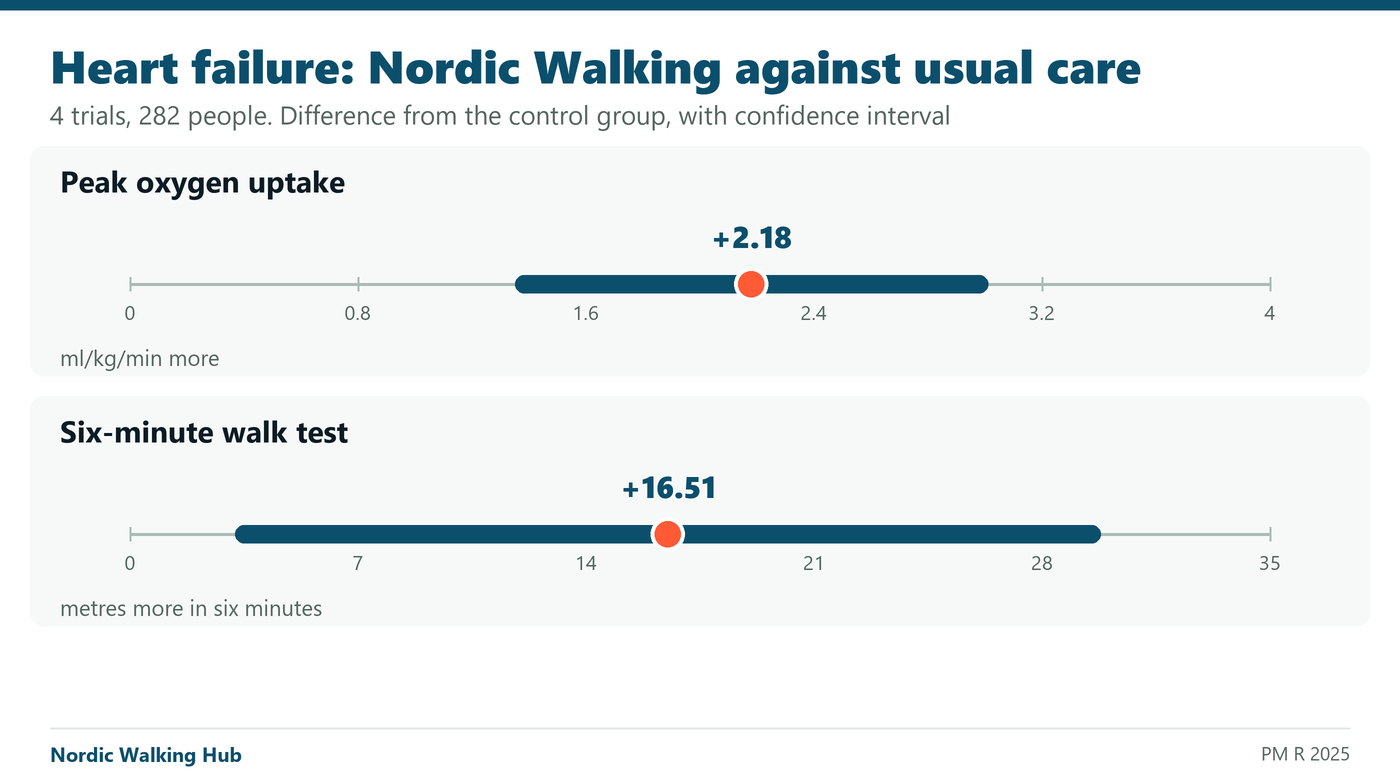
    • Peak oxygen uptake rose by 2.18 ml/kg/min more than in the control groups, the six-minute walk by 16.5 metres more.
    • The differences are not huge, but they point in the same direction. The authors call it a possibly useful part of cardiac rehabilitation.
    • Studies are few, which is why larger ones are needed.

    Who it is for

    The review concerns people with chronic heart failure and a reduced ejection fraction. That means the heart pumps out less blood with each beat than it should. Such people often get tired doing things that used not to be a problem: stairs, shopping, a walk with the grandchildren. It is precisely for them that it is important to find movement they can manage and that will help them.

    What the review did

    The authors searched three large databases and chose only randomised trials, that is ones in which who walks with poles and who does something else was decided by lot, not by the wishes of the people or the doctors. That makes the groups fairly comparable. They found four such trials, with 282 people in total. Nordic Walking was compared with standard cardiac rehabilitation or usual care.

    What the review found

    • Peak oxygen uptake, a measure of how much effort the body can manage, rose by 2.18 ml/kg/min more with Nordic Walking than in the control groups. The confidence interval was 1.35 to 3.01, so the true difference is probably somewhere in that range.
    • The distance in the six-minute walk test, that is how many metres you cover in six minutes, increased by 16.51 metres more. Here the interval is wider, 3.23 to 29.80 metres: the true difference may be small, but also almost thirty metres.

    The differences are not huge, but both point in the same direction, and that is the point: people who walked with poles did slightly better after the programme than those who did something else. The authors sum it up by saying that Nordic Walking may be a useful part of cardiac rehabilitation.

    Chart
    Photo from the trail

    How to read it

    Four studies are few, and the authors themselves write that larger studies with more varied patients are needed. So today we do not know whether the result would be the same for everyone. A meta-analysis adds up the results of several studies and works out a combined number, which is more reliable than the result of one small study. But four studies are still only four. Still, the numbers suggest that Nordic Walking can be a useful part of cardiac rehabilitation, and that is news worth having.

    Why it makes sense

    It is logical, even though the studies did not examine it: walking with poles is a movement that many people can manage who might not have the strength for running or cycling, and it can be done in a group and outdoors. Both matter for a long-term habit. Nothing is promised, but there is logic to it.

    What it means

    It is an encouraging signal, not a ready-made guide. Nothing is promised, and how and how much is decided by the people who treat and guide you. Poles offer movement that can be dosed in small steps and needs no equipment other than the poles.

    Do you walk with poles and your heart no longer works at full strength? Tell us in the forum how it is going and how you are starting. More than any study, the experience of someone in the same situation as you is useful.

    Frequently asked questions

    **May I walk with poles if I have heart failure?** The studies show that people with chronic failure and a reduced ejection fraction walked in the pole trials and did slightly better than the control groups. The individual pace and dose, though, are set by your condition, not by a table, which is why it pays to start slowly.

    **Is it better than usual rehabilitation?** The review does not say “better”. It says it came out somewhat higher for fitness and distance, but there are only four trials. Poles are not a replacement for rehabilitation, but they can be part of it.

    **Why are the studies so small?** Studies of sick people are hard to do and take a long time. The more people and the more varied the group, the more reliable the result. That is why the authors ask for larger studies.

    **What will it bring me in everyday life?** The six-minute walk test improved by 16.5 metres. That is not a huge gap, but it shows the body manages slightly more. In practice that may mean you manage stairs or shopping with less breathlessness.

    Photo from the trail

    Text: Kompas.

  • Nordic Walking with lung disease: as good as other exercise, not better

    People with lung diseases are often afraid of exercise. When you are short of breath, you do not feel like doing anything that might make it worse. Yet exercise is among the things recommended for lung diseases. How does Nordic Walking do?

    Photo from the trail

    What the 2025 review found

    The authors summarised 13 studies with 514 participants.

    • The qualitative summary, that is a description of results without a combined number, suggests a benefit for exercise tolerance, physical activity, fitness, breathlessness, lung function and mood.
    • A meta-analysis, that is a combined number, could only be done for the six-minute walk test, from seven studies. The difference against other types of exercise was 4.4 metres, that is practically none. The interval was wide, though: from a result 88.1 metres worse to one 96.9 metres better.
    • The authors’ conclusion: the benefits are comparable with other forms of exercise.

    Why “equally good” is good news

    Nordic Walking is not better than other exercise, but not worse either. Whoever enjoys it can choose it. Exercise that a person enjoys is done for a long time, and that matters most. You do not have to force yourself into something you hate just because it sounded more thorough.

    And poles have a practical side: with them you can walk more upright, and that often comes in handy for people who are short of breath. The studies did not measure this, though, we write it only as an observation, not as a finding.

    What we do not know yet

    The authors point out that studies with carefully set intensity for each person individually are missing. So we do not know how much the results would improve if the load were precisely adapted. Further research must answer that.

    Do you walk with poles and have trouble with your lungs? Tell us in the forum how walking is going and what helps.

    The six-minute walk test is simple: it measures how many metres a person covers on level ground in six minutes. It is used for other diseases too and is handy for comparison. A difference of 4.4 metres is negligible in this test, and that is why we say there was no difference between Nordic Walking and other exercise in it. The wide interval, though, reminds us that there are too little data for certainty.

    The main message is simple: you do not have to fear that you are choosing worse if you choose Nordic Walking. Pick the exercise that does not put you off after the first week, and stay with it.

    Photo from the trail

    What to take away

    In lung disease Nordic Walking came out as good as other exercise, not better. That is not bad news: it means you can choose the movement you enjoy and will stick with. Keep a pace at which you can still talk.

    Did you choose poles because you enjoy them, or have you tried other exercise too? Tell us what suits you best.

    Sources

    Text: Kompas.

Advertisement
Space for your advertisement

Your advertising helps us enormously. Thank you.

Want to be here? Write to us
Advertisement
Space for your advertisement

Your advertising helps us enormously. Thank you.

Want to be here? Write to us