You know it from walks, or from someone in your family: after a few hundred metres the calves start to hurt, the person stops, rests and walks on. With peripheral arterial disease, PAD, that is the typical picture. The gold standard is a supervised exercise programme, but it is not available everywhere. What if you live far from an exercise centre?
What the 2025 meta-analysis found
The authors pooled 8 studies with 508 patients and looked at how Nordic Walking does against supervised exercise.
In the maximum walking distance, supervised Nordic Walking did not differ from supervised exercise.
Neither did it in the distance to the first pain.
In the time people kept exercising, supervised training was better (SMD −0.41). That is a moderate difference.
The authors conclude that Nordic Walking is a usable option when supervised training is not available.
How to read it
Nordic Walking does not win here, but it does not have to. For someone who lives far from an exercise centre, “almost as good at home” is a big thing. The point is that exercise happens at all, and regularly. Walking with poles can be done in front of your house, in a park, on your way, and it needs no equipment other than the poles.
It is also interesting that people in the supervised groups kept exercising for longer. Having someone lead and watch over you evidently plays a role. If you walk with poles alone, try to find a group or a friend. People who exercise with someone usually do not give up so easily.
What we do not know yet
Two further studies did not make it into the calculation because their comparison groups were different, so their results could not be added to the others. More studies and longer follow-up would be good to have.
Do you know that pain in the calves, and do you walk with poles? Tell us in the forum how walking is going and what helps you.
In case the “SMD −0.41” means nothing to you: it is a standardised mean difference, a number that lets you compare studies that measured a little differently. Values around 0.2 are usually considered a small difference, around 0.5 a moderate one and around 0.8 a large one. Our −0.41 lies between small and moderate, and the minus means that supervised training was better. No huge gap, but not negligible either.
What to take away
With leg pain when walking, poles may help you go farther than you would without them. It is a fallback route, not a miracle: pain is a signal and worth taking to someone who can judge it. Poles may be only part of the answer.
Do you know the feeling of having to stop at a shop window even though you do not want to? Tell us whether poles lengthened your walk.
How much extra does the body use when walking with poles? Ask three people and you get three numbers. And in different papers you will find different numbers too. Nobody is lying, the studies just differ. Let us look at how to find your way through it, so that you are fooled neither by enthusiasm nor by scepticism, and so that you can answer when someone asks how much it really is.
In brief
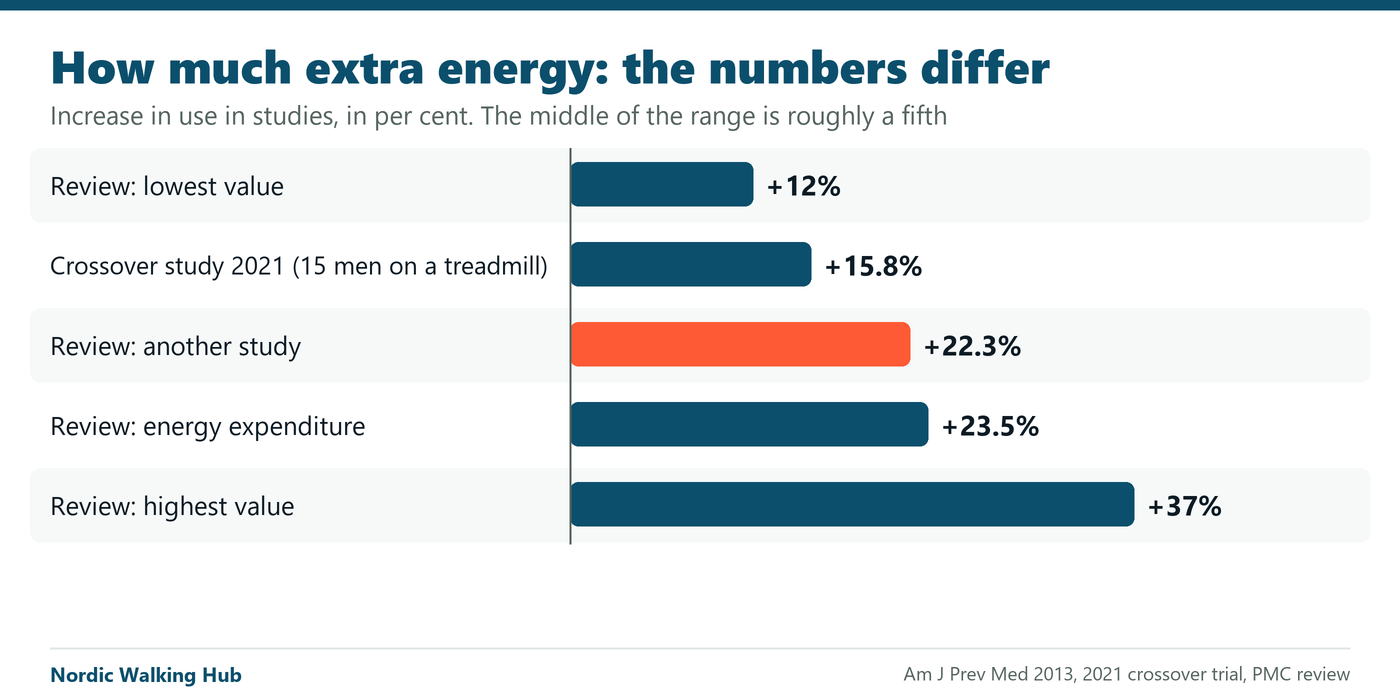
More energy is used with poles, but how much depends on whom and how it was measured: the numbers in studies run from roughly 12 to 37%.
The middle of the range is roughly a fifth extra. “A fifth more” is not made up, but it is not a promise for you.
The more numbers of the same kind you see, the better: reviews are more valuable than a single study.
You can measure it yourself: pulse on the same route with and without poles.
Examples from what we read
A crossover study from 2021: oxygen uptake 15.8% higher, in 15 young men on a treadmill where speed gradually rose from 3 to 5 km/h and the incline from zero to seven per cent.
A review cites other studies: an increase of 12%, 22.3% and 37%. In one, energy expenditure was 23.5% higher.
A systematic review from 2013 summarised 16 randomised studies with 1,062 patients and 11 observational ones with 831 patients. It found that with respect to heart rate, oxygen uptake and quality of life Nordic Walking is better than brisk walking without poles and in some measures even than jogging.
So the numbers run from a tenth to a third, and each of them is true. It just says something different, because it arose under different conditions.
What to ask about every number
Who was studied? Young men on a treadmill are different from a sixty-year-old woman in a forest.
How fast did they walk and for how long? At a higher pace the difference is different.
What technique did they use? Technique can influence the result.
What was the design? A randomised study is more reliable than a single measurement.
How large was the sample? Fifteen people is few.
What is the quality? A review of biomechanical papers had a moderate quality of 5.5 out of 10.
Next time you see a number on a package, in an advert or in the news, try asking yourself those questions. Most numbers contain no answer to them, and then it is good to take the number as a rough guide.
Why the numbers differ
Several things stand behind the differences at once. One is technique: whoever pushes off with the poles uses more than whoever drags them. Another is pace, because at a slow walk the difference fades and at a brisk one it grows. Another is terrain: on a hill the poles work differently than on the flat, and whoever tried Nordic Walking on a treadmill got a different number from the one in the forest. And finally there are the people: fifteen young men behave differently from a group of sixty-year-old women.
What to take from it
“A fifth more” is the middle of a wide range from roughly a tenth to a third. It is an honest summary, not a promise for a particular person. You have your own technique, your own pace and your own terrain, and that is why your number will be different. What matters is that the direction is clear: with poles you work harder.
A good rule: the more numbers of the same kind you see, the better. One number can be a lucky chance, ten numbers give a picture. That is why reviews are more valuable than a single study, and why it is better to trust a range than a single number.
Have you ever measured anything yourself? Say your pulse on the same route with and without poles? Tell us in the forum what you found.
Frequently asked questions
**Which figure is “the right one”?** None single. The right thing is the range, not a number. According to studies you burn roughly a tenth to a third more with poles, and your number depends on pace, technique and terrain.
**How can I measure it myself?** The simplest is the pulse. Walk the same route with and without poles, at the same speed, and look at your watch. The difference shows what poles do to your heart. If you want more exact figures, laboratory measurements are needed.
**Why can the numbers on pole packaging not be trusted?** They may be true, but they arose under conditions different from yours. Ask who was studied, how fast they walked and for how long. If the manufacturer does not answer, take the number as advertising.
**Does it mean that poles do nothing?** No. It means that the range is wide and that numbers cannot be transferred to individuals. The direction is clear: with poles you work harder.
Three things to remember
First: a number without conditions is just advertising. Second: a range is more honest than a single number. Third: the best gauge is the one you make yourself, on your own route, with your own pulse and your own feeling. These three rules will save you a lot of pointless arguing.
You often hear that Nordic Walking strengthens bones and prevents falls. It sounds logical: it is movement with body weight, and poles add confidence. But logic is not proof. What do the studies say? The honest answer is not what a pole seller would wish: about bones we know practically nothing, about mobility a little more. And we will say so straight out.
In brief
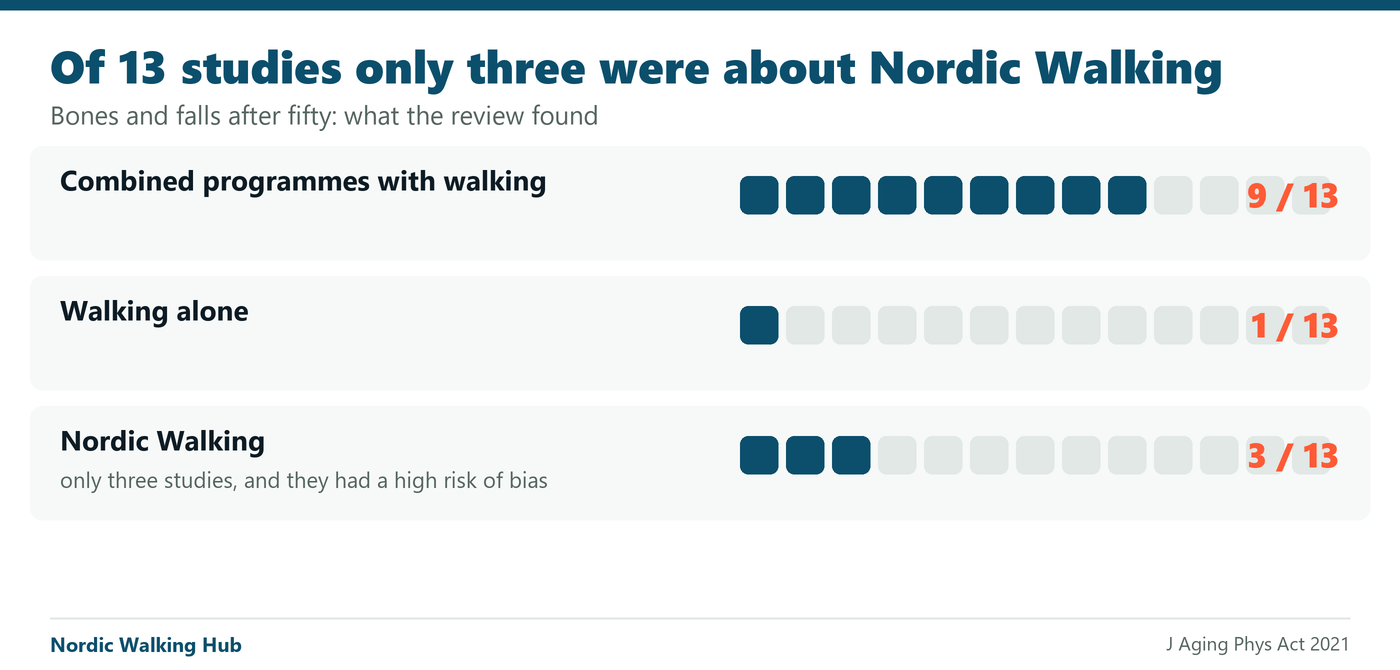
Of 13 studies only three were about Nordic Walking and most had a high risk of bias.
The “timed up and go” test may improve, but the certainty is very low. There was not enough data on bones and fractures.
“Nordic Walking protects against fractures” has no support. That does not mean it does not work, only that nobody has properly checked it.
Combined programmes with walking did better than walking alone: walk, but add balance and strength exercise.
What the review did
The authors looked for randomised studies in people aged 50 and over with low bone density and an elevated risk of fractures. They found 13: nine combined programmes with walking, one on walking alone and only three studies of Nordic Walking. Those three are the most important for our topic, and there are few of them.
What it found
Nordic Walking may improve the “timed up and go” test (by 1.39 s), but the certainty of this result is very low. In the test a person stands up from a chair, walks a few metres, turns and sits down again, and the time is measured.
Combined programmes with walking improved the six-minute walk test by 39 metres and, by a tiny bit, bone density in the lumbar spine, but the evidence is weak.
Bone density at the femoral neck and quality of life did not change significantly.
There was not enough data on fractures, falls and mortality.
Most studies had a high risk of bias.
Risk of bias means that the way the study was carried out may have influenced the result. For example that people and observers knew who exercised with poles. Such results are therefore taken with reservation.
What it means
The honest answer is: we do not know. The claim “Nordic Walking protects against fractures” has no support, because three studies are simply not enough for such a question. That does not mean it does not work. It means nobody has properly checked it yet. The authors recommend combining walking with other exercise, because combined programmes did better in several measures than walking alone.
The fewer studies and people there are, the more easily results can turn out nicely just by chance. That is why the authors speak of very low certainty and do not want to make big claims from three studies. When larger studies come, the answer may change in both directions: Nordic Walking may turn out better, but also worse, than we expected.
In practice
If you are afraid of falls, add balance and strength exercise alongside walking. Poles give you confidence while walking, but they are no substitute for keeping your legs and muscles in shape. For now the plain advice stands: walk because you enjoy it and it does you good, not because someone promised you strong bones.
Has it been your experience that poles help you keep your balance, say on slippery ground? Tell us in the forum. Individual experiences do not replace studies, but they help to know where to look.
Frequently asked questions
**I have low bone density. Should I try poles?** The review points mildly positive here: Nordic Walking may improve the “timed up and go” test, which is a functional performance, not bones. Mind what the review measured: function, that is how a person moves, not the strength of the bones.
**Is walking better, or strength training?** The review says combined programmes did better in several measures than walking alone. Try both: walking for fitness, strength training for muscles.
**What about falls?** Poles give you confidence while walking, but they do not improve static balance. Practise balance separately, say standing on one leg next to a firm support.
**What is “very low certainty”?** It is the technical term for the result possibly being different when further studies arrive. It is nothing bad, just honesty: the authors do not want to commit to a claim they have no way to support.
What you can do right now
The good news is that you can work on function, that is how you move, already today. Walk regularly, add balance and strength exercise once a week and try standing up from a chair without using your hands. Such things are exactly what the “timed up and go” test measured. Bones and falls are a subject for which we do not have enough evidence yet, but your mobility improves with work, not with a review.
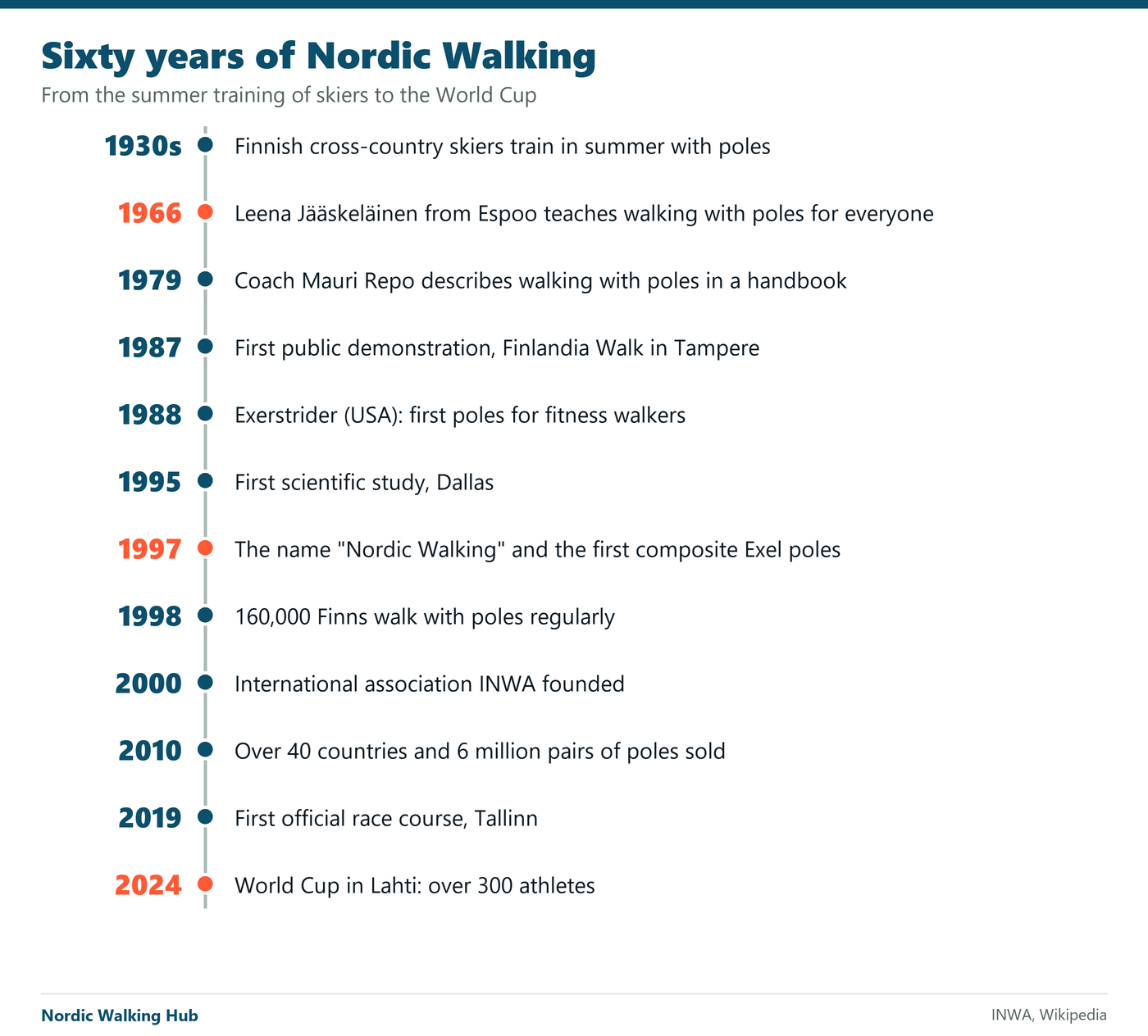
Who first set out with ski poles on asphalt? You might expect one name and one date. The truth is more interesting: nobody single-handedly invented Nordic Walking, it came together in pieces over about sixty years, in different hands and in different countries. Here is the whole story, from skiers who did not want to go soft in summer to World Cup races.
The 1930s: skiers without snow
The beginning is simple. According to the international Nordic Walking organisation INWA, Finnish competitive cross-country skiers were already using poles outside the season in the 1930s. The snow melted but fitness had to be kept up, so they walked and climbed hills with the same poles they knew from winter. It was not a new sport. It was a trick for surviving the summer.
1966: a PE teacher who wanted everyone to be able to do it
The turning point came in 1966. Leena Jääskeläinen, a PE teacher from Espoo in Finland, came up with an idea that sounded almost laughable at the time: walking with ski poles as fitness for everyone, not just for athletes. The poles were meant to engage the whole body, not just the legs, in people who had never heard of skiing. Her name is rarely mentioned today, but it was she who turned a summer trick into movement for ordinary people. She prepared a public demonstration only in 1987, at the Finlandia Walk event in Tampere, so from the idea to the first public showing it took twenty-one years.
1979: coach Repo writes it in a handbook
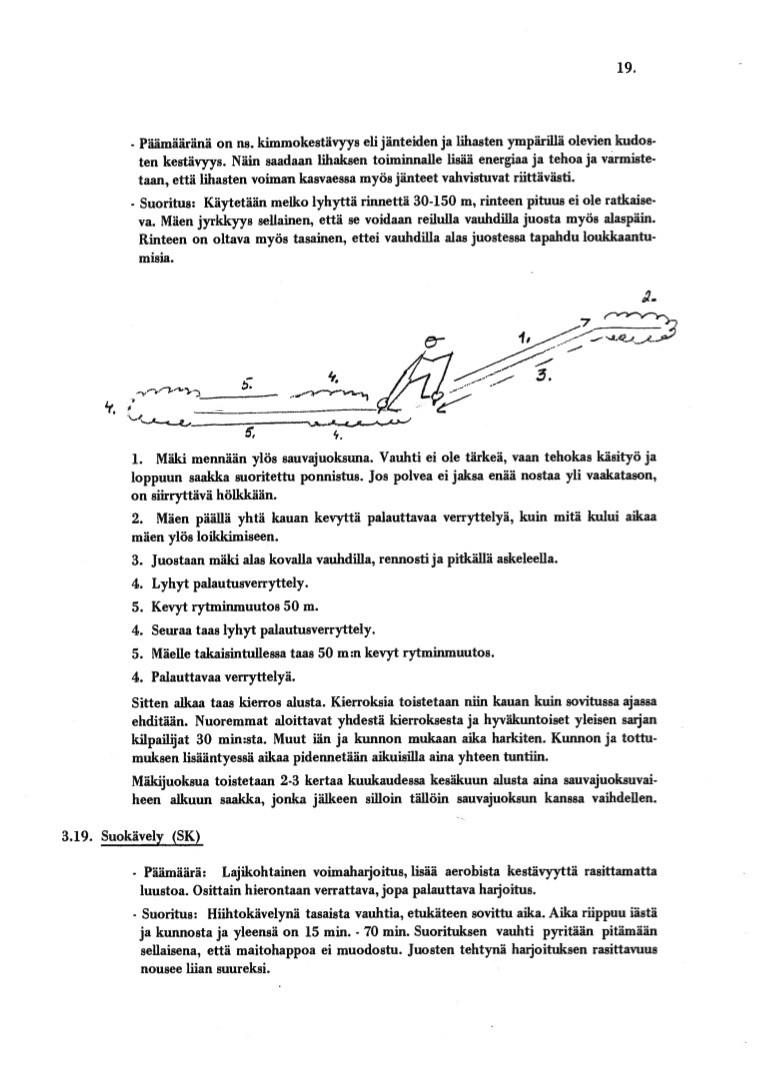
At about the same time, coach Mauri Repo, the former head coach of cross-country skiing in the Finnish federation, was dealing with the subject too. In 1979 he described walking with poles as part of his training system in the manual *Hiihdon lajiosa*, that is “Parts of skiing”. For skiers it was one of the summer parts of training. The picture below is the original page from his materials, with a description of the exercise.
From coach Mauri Repo’s teaching material, 1979.
It is one of the oldest surviving descriptions of walking with poles as part of training. You do not have to understand Finnish to see what it is about: a diagram of a hill, numbered stretches and instructions on how to walk and rest. The basis is there: movement that engages the arms and so trains more than walking alone could.
1988: the first poles for ordinary walkers
Nine years later, in 1988, the American company Exerstrider made, according to Wikipedia, the first poles designed directly for fitness walkers. That turned improvisation into a product: they were no longer just ski poles, but poles designed directly for walking. That this happened in the USA and not in Finland shows that the idea travelled and only needed the right tool.
1995–1998: science and a name
In 1995 the first scientific study of walking with poles was published, in the journal *Medicine and Science in Sports and Exercise*, and it came from the Kenneth Cooper Institute in Dallas. That was the moment when an “interesting idea” became something that could be measured. A year later the Finnish federation Suomen Latu joined with the Vierumäki sports institute and the pole maker Exel to organise the activity.
In 1997 the name appeared. According to INWA it was coined by Aki Karihtala and the Exel team, and Exel at the same time launched the first composite Nordic Walker poles. Wikipedia places the spread of the name two years later, in 1999, and both statements may hold: one about when the name arose, the other about when it caught on. In 1998 in Finland 160,000 people walked regularly with poles and half a million had at least tried. Finland even gave Nordic Walking the award *Health Promoting Action of the Year*.
2000 and on: from Finland to the world
In 2000 Aki Karihtala founded in Finland the International Nordic Walking Association INWA, devoted to education and promotion. In 2001 Nordic Walking appeared for the first time at the ISPO sporting goods fair and Exel began distributing poles worldwide. Nine years later, in 2010, people walked with poles in more than forty countries and Exel had sold six million pairs. In the same year the first World Nordic Walking Day took place, on 10 October 2010.
The next chapter is organised: between 2016 and 2019 INWA trained over a hundred instructors in China and introduced World Cup races. In 2019 the first official race course was created in Tallinn. And in 2024 over three hundred athletes competed in a World Cup race in Lahti, Finland. That a summer trick of cross-country skiers became a competitive discipline is something the skiers of the thirties would hardly have expected.
So who invented it?
The sources differ in detail, which is why the honest answer is this: nobody alone. Skiers came with the poles, Jääskeläinen with the idea for everyone, Repo with the description in a handbook, Exerstrider with the first poles, Exel with the name and with worldwide sales, and INWA with education. Each added a piece. Whoever looks for one name will find five, and none is wrong.
What it means for you
Nordic Walking is a young sport with roots that can be followed back less than a century. The poles you hold are the result of sixty years of trying: they are lighter than ski poles, have a strap, replaceable tips and a length you choose according to your height. That you walk today with poles along a forest path has its basis in the summer training of skiers from the thirties and in the idea of one PE teacher that everyone should be able to do it.
When someone in the street asks you “where are your skis”, they have actually hit closer than they know.
Do you know anything about the history of Nordic Walking where you live, about the first groups or the first poles? Tell us in the forum. You will not read such stories anywhere else. And if you are interested in races, look at the events calendar.
Nordic Walking Hub is made through shared work: the observations and impressions of people, and the contribution of the huge knowledge base of artificial intelligence. We say so openly and we are proud of it. There is nothing secret or misunderstood about it, and we believe that whoever knows how texts come about can trust them more.
How it works
People bring experience from trails, forests and many years of walking with poles. They know how cold wind feels to a hand in a glove, what a tip does on ice and why after three hours a person would rather turn back.
Artificial intelligence adds a breadth of knowledge that no single person has. It helps find sources, summarise studies and write texts. It also does a great deal of work in translating into English and German, so the portal speaks three languages and nobody has to wait for a translator.
Every claim rests on a source linked under the article. The numbers are taken from the abstracts of studies. Nobody is very interested in sources, which is why you find them tucked away in one line under the article, but they are there.
Where AI helps and where people decide
AI searches, reads, summarises and proposes. People decide what belongs on the portal, what its tone should be and what gets published. No rule of the portal, no intention, no contact with people is invented by a machine. That is ours.
What AI does not do
It does not invent experiences. Stories from the trail, the opinions of members and answers in the forum are human and are never written by a machine. It does not pretend to be a member, and nobody here has made-up accounts or made-up discussions. Where we are only beginning we say so, and we do not want to pretend there are more people than there are.
Why we say it
Because honesty matters to us. Nordic Walking is a sport for people who like to look at things properly, so it seems right to us that it should also be known how the portal is made. One thing is certain: AI makes mistakes, which is why it matters that it is not only machines here.
Found a mistake?
Write to us on the Contact page. We will fix it and say what we changed. We are glad to fix mistakes and we are not ashamed of them, because every correction means somebody read carefully.
Want to write with us?
What to take away
When you read an article on this portal, you know that people stand behind it and that every claim has a source. The machine suggests, people decide. If something does not match your experience, tell us: your experience is worth more to us than any handbook.
What would you like to read on the portal, and what bores you? Tell us in the forum, and if you feel like it, try writing an article yourself.
The best articles arise when experience meets the wish to share it. If you have something to say about poles, routes, technique or how you started, try writing your own article. There are instructions on the page Write an article.