


You often hear that Nordic Walking strengthens bones and prevents falls. It sounds logical: it is movement with body weight, and poles add confidence. But logic is not proof. What do the studies say? The honest answer is not what a pole seller would wish: about bones we know practically nothing, about mobility a little more. And we will say so straight out.

In brief
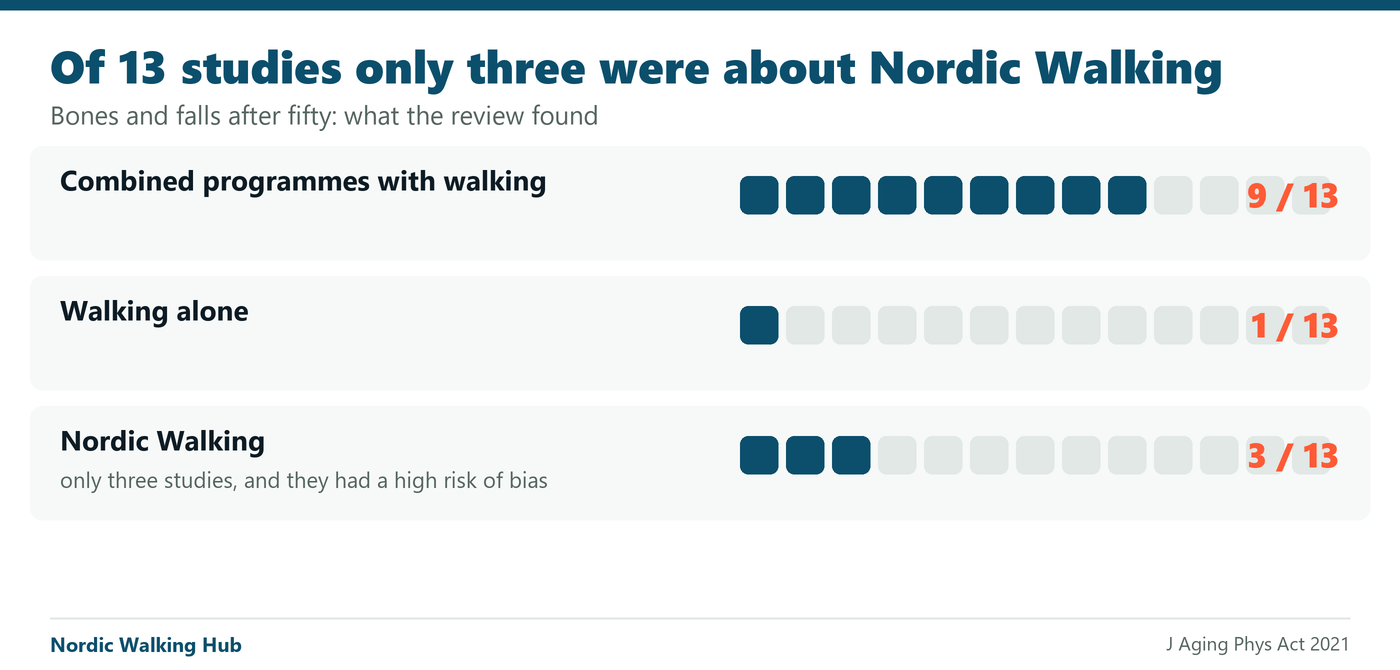
- Of 13 studies only three were about Nordic Walking and most had a high risk of bias.
- The “timed up and go” test may improve, but the certainty is very low. There was not enough data on bones and fractures.
- “Nordic Walking protects against fractures” has no support. That does not mean it does not work, only that nobody has properly checked it.
- Combined programmes with walking did better than walking alone: walk, but add balance and strength exercise.
What the review did
The authors looked for randomised studies in people aged 50 and over with low bone density and an elevated risk of fractures. They found 13: nine combined programmes with walking, one on walking alone and only three studies of Nordic Walking. Those three are the most important for our topic, and there are few of them.
What it found
- Nordic Walking may improve the “timed up and go” test (by 1.39 s), but the certainty of this result is very low. In the test a person stands up from a chair, walks a few metres, turns and sits down again, and the time is measured.
- Combined programmes with walking improved the six-minute walk test by 39 metres and, by a tiny bit, bone density in the lumbar spine, but the evidence is weak.
- Bone density at the femoral neck and quality of life did not change significantly.
- There was not enough data on fractures, falls and mortality.
- Most studies had a high risk of bias.
Risk of bias means that the way the study was carried out may have influenced the result. For example that people and observers knew who exercised with poles. Such results are therefore taken with reservation.

What it means
The honest answer is: we do not know. The claim “Nordic Walking protects against fractures” has no support, because three studies are simply not enough for such a question. That does not mean it does not work. It means nobody has properly checked it yet. The authors recommend combining walking with other exercise, because combined programmes did better in several measures than walking alone.
The fewer studies and people there are, the more easily results can turn out nicely just by chance. That is why the authors speak of very low certainty and do not want to make big claims from three studies. When larger studies come, the answer may change in both directions: Nordic Walking may turn out better, but also worse, than we expected.
In practice
If you are afraid of falls, add balance and strength exercise alongside walking. Poles give you confidence while walking, but they are no substitute for keeping your legs and muscles in shape. For now the plain advice stands: walk because you enjoy it and it does you good, not because someone promised you strong bones.
Has it been your experience that poles help you keep your balance, say on slippery ground? Tell us in the forum. Individual experiences do not replace studies, but they help to know where to look.
Frequently asked questions
**I have low bone density. Should I try poles?** The review points mildly positive here: Nordic Walking may improve the “timed up and go” test, which is a functional performance, not bones. Mind what the review measured: function, that is how a person moves, not the strength of the bones.
**Is walking better, or strength training?** The review says combined programmes did better in several measures than walking alone. Try both: walking for fitness, strength training for muscles.
**What about falls?** Poles give you confidence while walking, but they do not improve static balance. Practise balance separately, say standing on one leg next to a firm support.
**What is “very low certainty”?** It is the technical term for the result possibly being different when further studies arrive. It is nothing bad, just honesty: the authors do not want to commit to a claim they have no way to support.
What you can do right now
The good news is that you can work on function, that is how you move, already today. Walk regularly, add balance and strength exercise once a week and try standing up from a chair without using your hands. Such things are exactly what the “timed up and go” test measured. Bones and falls are a subject for which we do not have enough evidence yet, but your mobility improves with work, not with a review.

Text: Kompas.

Join the discussion
Members can comment. Log in or create a free account.