


How much extra does the body use when walking with poles? Ask three people and you get three numbers. And in different papers you will find different numbers too. Nobody is lying, the studies just differ. Let us look at how to find your way through it, so that you are fooled neither by enthusiasm nor by scepticism, and so that you can answer when someone asks how much it really is.

In brief
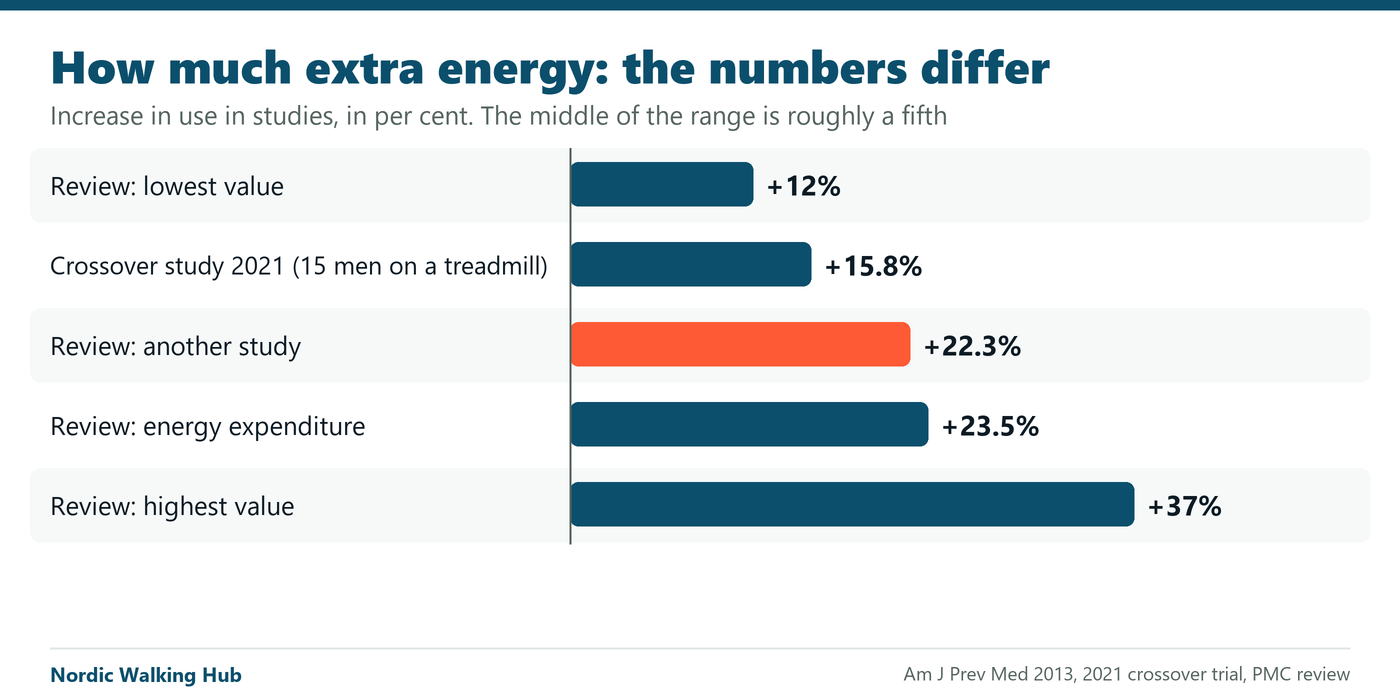
- More energy is used with poles, but how much depends on whom and how it was measured: the numbers in studies run from roughly 12 to 37%.
- The middle of the range is roughly a fifth extra. “A fifth more” is not made up, but it is not a promise for you.
- The more numbers of the same kind you see, the better: reviews are more valuable than a single study.
- You can measure it yourself: pulse on the same route with and without poles.
Examples from what we read
- A crossover study from 2021: oxygen uptake 15.8% higher, in 15 young men on a treadmill where speed gradually rose from 3 to 5 km/h and the incline from zero to seven per cent.
- A review cites other studies: an increase of 12%, 22.3% and 37%. In one, energy expenditure was 23.5% higher.
- A systematic review from 2013 summarised 16 randomised studies with 1,062 patients and 11 observational ones with 831 patients. It found that with respect to heart rate, oxygen uptake and quality of life Nordic Walking is better than brisk walking without poles and in some measures even than jogging.
So the numbers run from a tenth to a third, and each of them is true. It just says something different, because it arose under different conditions.
What to ask about every number
- Who was studied? Young men on a treadmill are different from a sixty-year-old woman in a forest.
- How fast did they walk and for how long? At a higher pace the difference is different.
- What technique did they use? Technique can influence the result.
- What was the design? A randomised study is more reliable than a single measurement.
- How large was the sample? Fifteen people is few.
- What is the quality? A review of biomechanical papers had a moderate quality of 5.5 out of 10.
Next time you see a number on a package, in an advert or in the news, try asking yourself those questions. Most numbers contain no answer to them, and then it is good to take the number as a rough guide.

Why the numbers differ
Several things stand behind the differences at once. One is technique: whoever pushes off with the poles uses more than whoever drags them. Another is pace, because at a slow walk the difference fades and at a brisk one it grows. Another is terrain: on a hill the poles work differently than on the flat, and whoever tried Nordic Walking on a treadmill got a different number from the one in the forest. And finally there are the people: fifteen young men behave differently from a group of sixty-year-old women.
What to take from it
“A fifth more” is the middle of a wide range from roughly a tenth to a third. It is an honest summary, not a promise for a particular person. You have your own technique, your own pace and your own terrain, and that is why your number will be different. What matters is that the direction is clear: with poles you work harder.
A good rule: the more numbers of the same kind you see, the better. One number can be a lucky chance, ten numbers give a picture. That is why reviews are more valuable than a single study, and why it is better to trust a range than a single number.
Have you ever measured anything yourself? Say your pulse on the same route with and without poles? Tell us in the forum what you found.
Frequently asked questions
**Which figure is “the right one”?** None single. The right thing is the range, not a number. According to studies you burn roughly a tenth to a third more with poles, and your number depends on pace, technique and terrain.
**How can I measure it myself?** The simplest is the pulse. Walk the same route with and without poles, at the same speed, and look at your watch. The difference shows what poles do to your heart. If you want more exact figures, laboratory measurements are needed.
**Why can the numbers on pole packaging not be trusted?** They may be true, but they arose under conditions different from yours. Ask who was studied, how fast they walked and for how long. If the manufacturer does not answer, take the number as advertising.
**Does it mean that poles do nothing?** No. It means that the range is wide and that numbers cannot be transferred to individuals. The direction is clear: with poles you work harder.
Three things to remember
First: a number without conditions is just advertising. Second: a range is more honest than a single number. Third: the best gauge is the one you make yourself, on your own route, with your own pulse and your own feeling. These three rules will save you a lot of pointless arguing.

Text: Kompas.

Join the discussion
Members can comment. Log in or create a free account.