

Poles are not just “something in your hand”. They change how we walk: a longer stride, a different rhythm, a different use of muscles. But by how much? A 2020 review pooled the numbers from more than forty studies, so we do not have to guess. And the result is more interesting than you might expect, because it is not only how fast you walk that changes, but also how the body moves while walking.
In brief
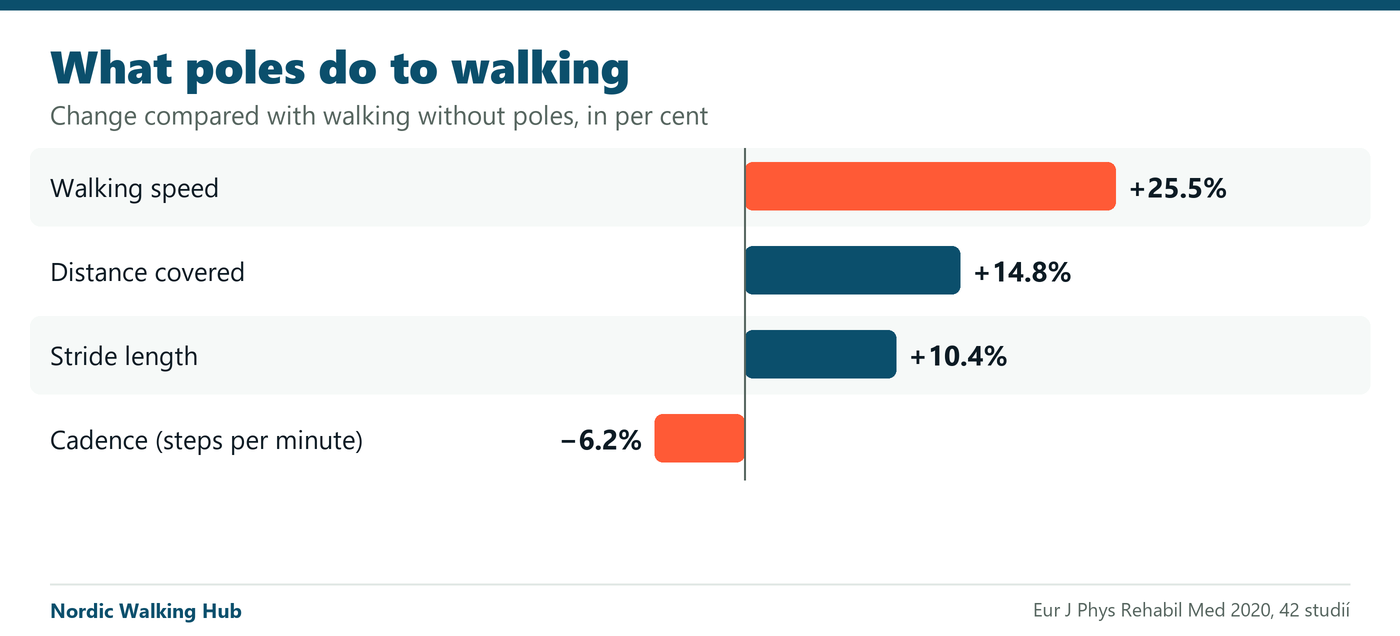
- Review of 42 studies: with poles the distance covered is 14.8% greater, speed 25.5% higher and stride 10.4% longer, cadence 6.2% lower.
- The muscles of the upper half of the body work more and the range of motion in the joints grows.
- Ground reaction force at footfall does not fall, it rather rises: poles do not automatically spare the legs.
- The numbers are averages. They depend on technique, yours will be different.
What the review did
The authors searched databases from October 2008 to October 2018 and selected 42 studies. Their average quality was 5.5 out of 10 points on the PEDro scale, a common scale for rating the quality of clinical studies. They wanted to know what poles do to speed and distance, to muscle activity, to the stride, to movement in the joints and to how hard you step on the ground.
What it found
Compared with walking without poles:
- the distance covered was greater by 14.8%,
- walking speed was greater by 25.5%,
- stride length was greater by 10.4%,
- cadence, that is the number of steps per minute, was lower by 6.2%.
In addition, muscle activation and strength of the upper limbs, the range of motion of the upper and lower limbs and the ground reaction force increased, the force with which the ground pushes you back at every footfall.
How to read it
A longer stride at a lower cadence is exactly what you would expect from pushing off with poles: you push off, send the body further and do not have to shuffle as much. That is why you go faster and cover more, even though you take fewer steps per minute. Speed even came out a quarter greater, which is a decent number for a single small thing, poles in your hands.
To give you an idea of what the percentages mean: 14.8% of five kilometres is roughly 740 metres. And 25.5% more speed means that if you walk four kilometres an hour without poles, with poles you might walk roughly a kilometre an hour faster. These are averages from studies, your numbers will differ, but the order of magnitude is easy to see.
A cadence lower by 6.2% does not mean you are walking lazily. The steps are longer, so you need fewer of them for the same distance, and when walking with poles the body moves further with each push.
What the upper half of the body does
The muscles of the arms, shoulders and trunk work more, and above all they have something to do: the poles push off through them. The authors describe greater activation and strength of the upper limbs and a greater range of motion in the joints of the arms and legs. That is the difference from ordinary walking: it is not only about the legs, it is about the whole body. It also explains why you feel different after Nordic Walking than after a stroll: sometimes the next day it is your shoulders that ache, not your calves.
An interesting point about the knees
The increased ground reaction force is interesting. It is not true that poles automatically reduce the load on the legs. In the article about knees we showed that the evidence is mixed, and this number confirms it: with poles you go faster, and the legs may therefore feel a greater force at each footfall.
What we do not know yet
The average quality of the studies was only moderate, and the numbers depend on technique. Someone who walks with poles correctly will have a different number from someone who only holds them. Nobody can tell you the exact number for you, but the direction is clear. The authors conclude that Nordic Walking has beneficial effects on many biomechanical parameters and may be an effective way of moving that suits rehabilitation and everyday life.
Do you notice a difference in your stride with and without poles? Tell us in the forum what yours is.
Frequently asked questions
**How do I know I am using the poles correctly?** If you push off, the hand reaches behind the hip, the pole points diagonally backwards and you feel it helping you forward, you are on the right track. The simplest thing is to have yourself filmed from the side.
**Why do my shoulders ache the next day?** Because the upper half of the body works, which it does not in ordinary walking. The ache should not be sharp. If it is just like after a day’s work, that is good news.
**Is faster walking with poles better for health?** Whoever walks faster uses more energy, and that is useful. But speed is not the goal. The review says that poles change the movement, not that faster walking is better.
**Does it save breath, or does it exhaust me?** Both, depending on pace. At a calm walk the difference fades, at a brisk one it grows. That is why the talk test is good: choose the pace at which you can still talk comfortably.
Text: Kompas.

Join the discussion
Members can comment. Log in or create a free account.