


People with long-term pain or fatigue look for movement that will not hurt them. Movement is needed, but when your whole body hurts or you are exhausted in the morning, you do not feel like doing anything. And you fear that exercise will make everything worse. What does a 2024 review say about Nordic Walking? It is reassuring reading, at least for those who want to get moving.

In brief
- Review of 14 studies, 20 to 136 people, programmes of 6 to 24 weeks, 2 to 4 days a week, 25 to 75 minutes.
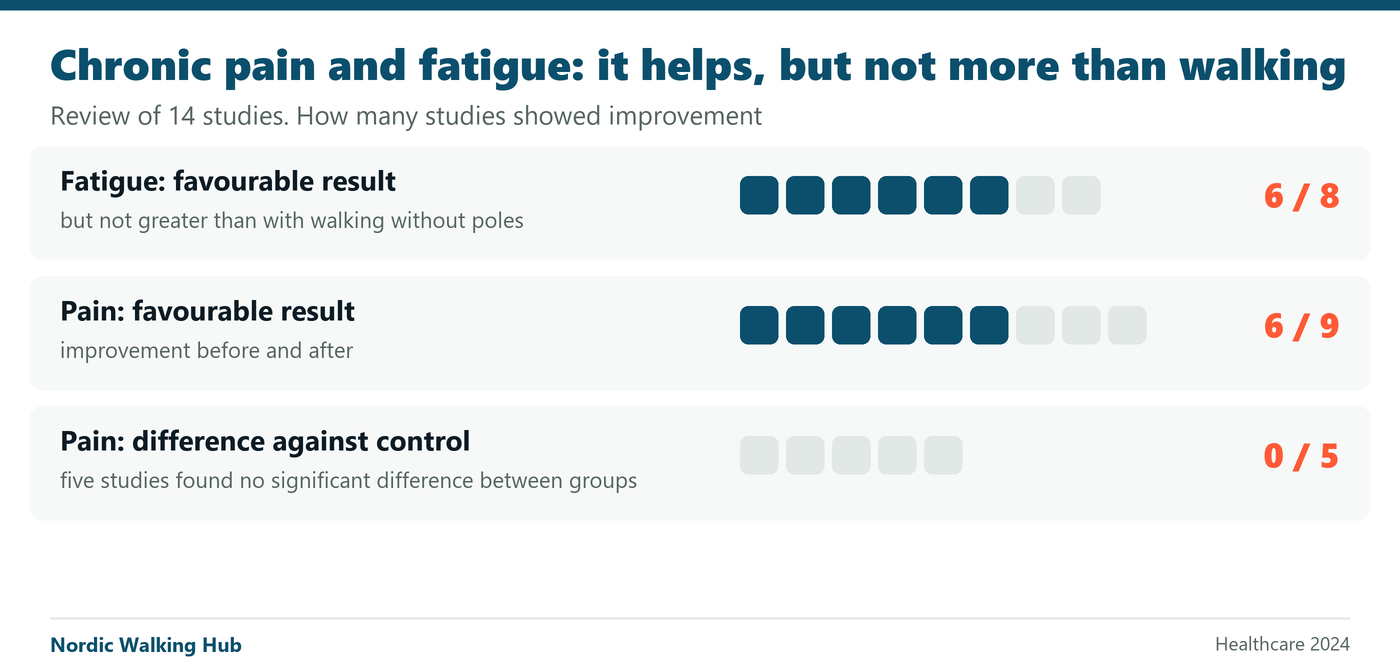
- Fatigue improved in 6 of 8 studies, pain in 6 of 9. Against control or against walking without poles, though, the improvement was not greater.
- Poles are not a magic pill. What helps is regular movement and that you stick with it.
- It is easy to learn and is led in a group, which helps persistence.
What the review did
The authors searched five databases and chose randomised trials in which Nordic Walking was tried for pain and fatigue. They found 14 studies, with 20 to 136 participants. Quality was fair in five studies and good in nine. The programmes were led: it was supervised Nordic Walking lasting 6 to 24 weeks, two to four days a week, for 25 to 75 minutes.
What it found
- Fatigue: 6 of 8 studies had a favourable result. Compared with ordinary walking (2 studies) or with no activity (1 study), though, it was not greater.
- Pain: 6 of 9 studies had a favourable result. Five studies that compared groups with each other, however, found no significant difference.
In other words: most people felt relief after the programme, but so did those who walked without poles or did nothing special. So poles on their own are not a magic pill.

How to read it
Improvement “before and after” does not mean that Nordic Walking in particular is responsible for it. People might improve on their own, or thanks to regular movement in general. The authors nevertheless write that it is a potentially effective method and that it is easy to learn, which may increase persistence. And persistence is the key with chronic pain: movement helps mainly those who stick with it.
Besides, improvement in people with chronic complaints is often not only about numbers on a pain scale. It is about going out again, someone smiling at you and having a plan for tomorrow. That is not counted in studies, but we are convinced that it plays a role.
What we do not know yet
We do not know whether it is better for pain than ordinary walking. The studies were mostly not large, and people with chronic pain are very different. What relieves one may not relieve another.
So if you enjoy poles, try them. If not, ordinary walking will probably do a similar service. What matters is that you move in a way that does not put you off.
If you want to run your own experiment, the studies give a reasonable frame: two to four days a week, 25 to 75 minutes, at least six weeks. Write in a calendar how you feel, even just a number from one to ten, and after six weeks compare the first and the last week. Numbers in a calendar are more honest than memory.
And one more thought: with chronic pain it is often about giving the body back the confidence that movement is not dangerous. A slow pace, poles in your hands and a walk outdoors can be a good first step.
Do you suffer from long-term pain or fatigue? Tell us in the forum what helps you. We will all learn from each other.
Frequently asked questions
**Will exercise make my pain worse?** The review reports no worsening. Most studies showed improvement. That does not mean you should not start slowly, though. A slow pace and short walks are a better start than a long day after which you cannot move.
**Should I walk even on a day when it hurts more?** That is up to you. The studies had a programme of two to four days a week, so rest days bothered nobody. Listen to your body, but do not let the pain decide everything.
**Should I exercise alone or in a group?** The programmes in the studies were led, that is in a group. Company helps you persist. If you have no group, a friend is enough.
**How do I know it is helping?** Try writing in a calendar a number from one to ten for how you feel. After six weeks compare the first and the last week. Numbers in a calendar are more honest than memory.
Why a “group” helps
The programmes in the studies were led and took place in a group, and that is probably no accident. People with chronic pain and fatigue easily withdraw into their homes. When someone is waiting for you at the stop, you get up even on a day when you do not feel like it. If you are looking for a group near you, see the group directory. And if there is nobody there, try writing in the forum: perhaps someone will respond.

Text: Kompas.

Join the discussion
Members can comment. Log in or create a free account.