


After breast cancer treatment, gentle movement for the whole body is helpful, and poles engage the shoulders and back too, the places that often stay stiff after surgery and radiotherapy. What is known about Nordic Walking after breast cancer? Two reviews, one from 2019 and one from 2026, give a fairly concrete answer: it helps, but the studies are small, which is why it is good to hold off on big promises.

In brief
- Two reviews, 2019 and 2026, with dozens of studies in total on women after breast cancer.
- Improvement in fitness, range of motion in the shoulder, posture and in some studies also lymphoedema, pain and psychological wellbeing.
- The studies are small and of varying quality, but the results point in the same direction.
- Begin with short walks at an easy pace and do not force the arm into anything that hurts.
Why poles
After breast cancer treatment women often struggle with long-term physical and psychological difficulties that affect quality of life. Exercise-based rehabilitation is increasingly recommended for them. Walking with poles fits in: it engages the arms and trunk, opens the chest and keeps the body upright, and it is a smooth movement outdoors, not a workout in a gym.
The 2019 review
It included nine studies, four randomised and five without random allocation. According to the authors, Nordic Walking had a positive effect on a number of complaints, including lymphoedema, that is swelling of the arm, as well as fitness and the feeling of disability. Nobody reported adverse effects. The quality of the studies was average to weak, which is why the authors ask for further research.
The 2026 review
It is newer and larger. The authors searched six databases from their beginnings to the end of 2025, with no language restriction, and from 281 records found selected 17 studies. They covered Nordic Walking alone and in combination with other exercise. The authors report:
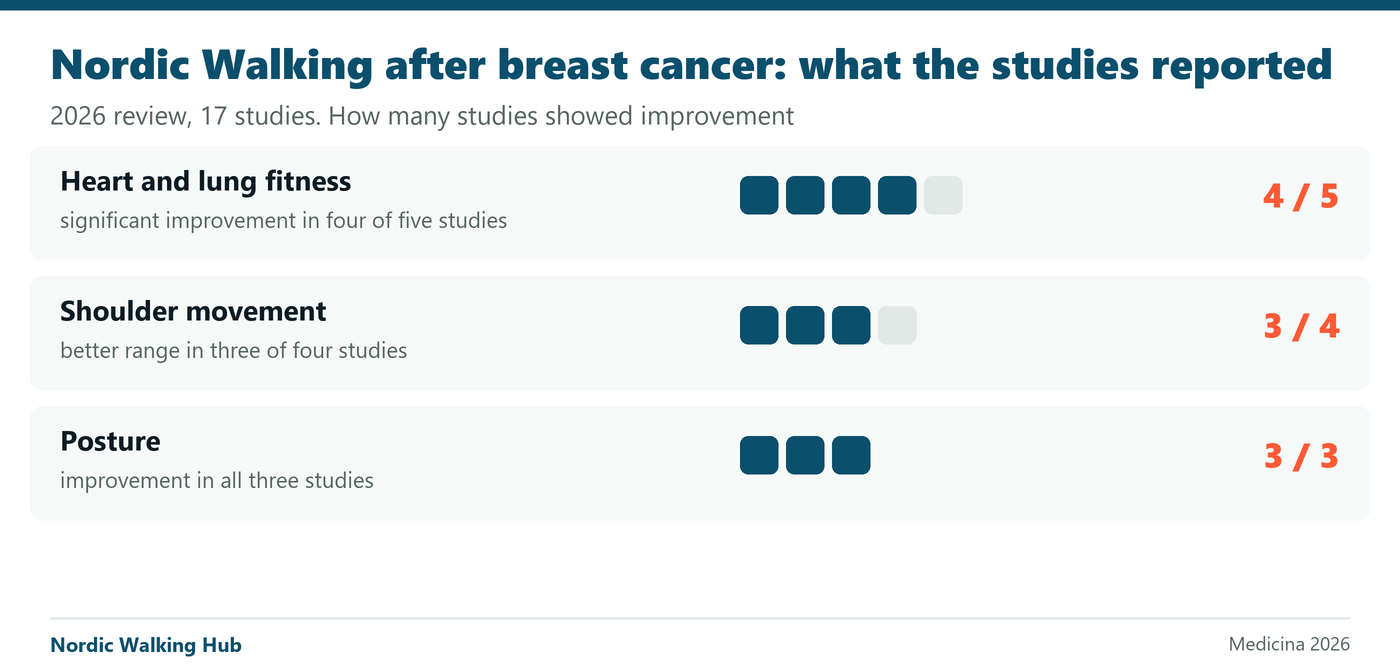
- improved heart and lung fitness in five studies (significant in four of them),
- better range of motion in the shoulder in three of four studies, mainly after stand-alone Nordic Walking,
- better posture in all three studies that followed it,
- improved strength in five studies and flexibility in one,
- lasting reduction of lymphoedema mainly after programmes lasting several weeks, especially in combination with the ISA method, in seven studies that assessed lymphoedema,
- improvement in pain, psychological wellbeing and quality of life in several studies.
How to read it
These are small studies of varying quality. The 2026 review describes what each study found, not certainty. In other words: the results go in the same direction, but there is not yet enough firm evidence to promise anything. The authors nevertheless conclude that Nordic Walking appears to be an effective, holistic form of exercise that helps in both physical and psychological respects.
What it means
What recurs most in the reviews is posture, range of motion in the shoulder and fitness. Those are things that walking with poles engages naturally, so it is logical. From that a simple start can be drawn: short walks at an easy pace, holding the poles loosely and keeping the shoulders relaxed. If the arm hurts after surgery or radiotherapy, adjust the pace and the length of the walk. Nobody is chasing you.
It is just as logical to start slowly and not to force the arm into anything that hurts. With lymphoedema one important thing appears in the review: lasting reduction is mentioned mainly after programmes that lasted several weeks. So do not expect a change after one walk, count on weeks.
Do you have experience with Nordic Walking after breast cancer treatment? Tell us in the forum how you started and what helped. Such experiences are read by women who are standing before that same question right now, and for them every story is precious.
Frequently asked questions
**When should I start after treatment?** The reviews describe programmes lasting several weeks, at an easy pace, mostly led. Begin with short walks and watch how the arm reacts.
**Will it help with arm swelling?** The 2026 review reports lasting reduction of lymphoedema, mainly after programmes lasting several weeks and in combination with the ISA method. No change is expected from individual walks. Count on weeks.
**Is it better to do Nordic Walking alone or with other exercise?** The review included both. Range of motion in the shoulder improved mainly after stand-alone Nordic Walking, flexibility and strength rather in combined programmes. Both make sense.
**Is it only physical, or psychological too?** Several studies reported better psychological wellbeing and quality of life. Movement outdoors, in a group and at an easy pace is often as important for the head as for the body.

Text: Kompas.

Join the discussion
Members can comment. Log in or create a free account.