


Hip osteoarthritis hurts and limits movement. An operation, a hip replacement, removes the pain, but weakness in movement can remain for months: a person cannot stand up from a chair properly, fears stairs and walks carefully. Does it occur to you that poles might help? Researchers wondered about that too, and eight trials with 468 people give a fairly clear answer.

What the review did
It is a scoping review from 2026. The authors searched seven databases from 2000 to February 2026 for trials in adults who have hip osteoarthritis or have had a hip replacement. They selected eight randomised trials with 468 participants. Quality was moderate to good, the weak spot was blinding: people of course knew whether they were walking with poles or not.
A scoping review maps what has already been studied and shows the gaps. It does not look for one combined number like a meta-analysis, so it shows a direction, not the exact size of an effect. The direction here is good, but do not expect from it the exact number of how much poles help.
What was measured and what improved
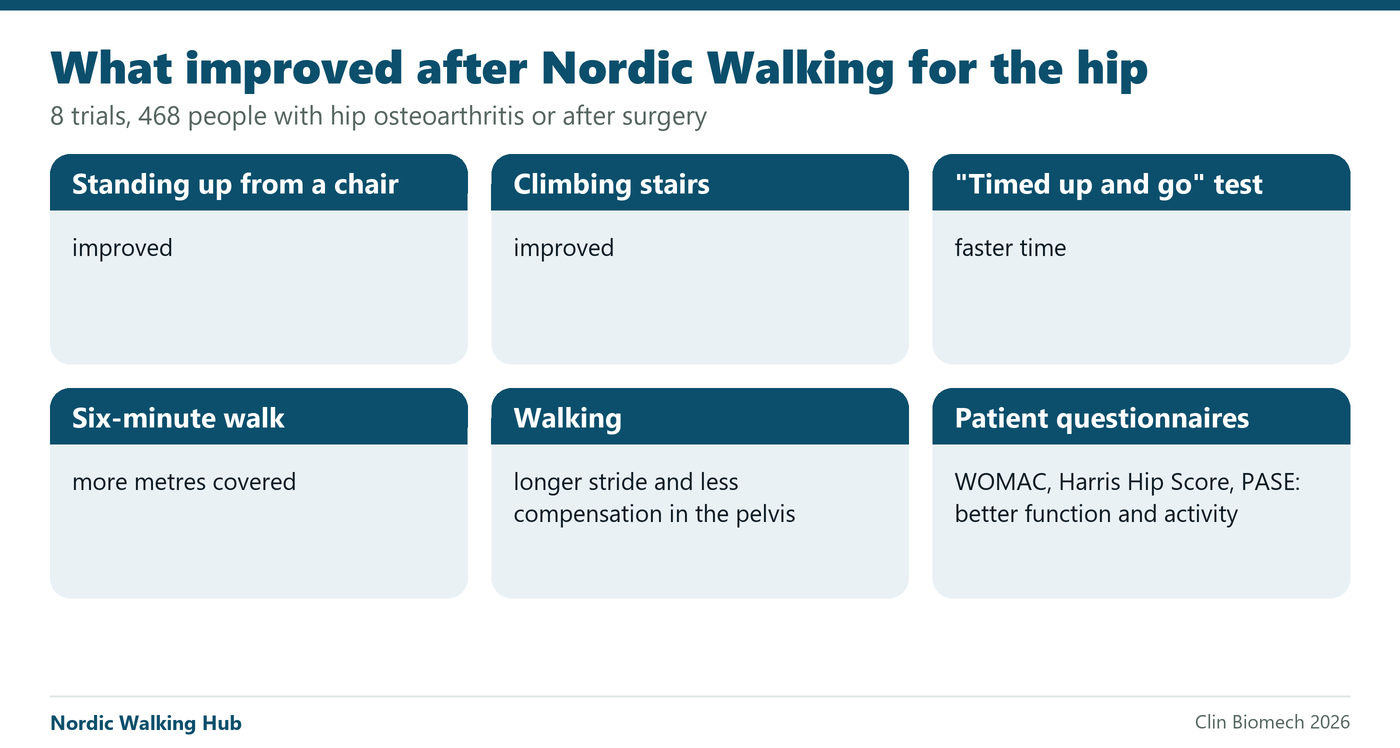
The authors followed two groups of outcomes. The first are performances that can be measured with a stopwatch and a tape measure:
- standing up from a chair,
- climbing stairs,
- the “timed up and go” test, in which a person stands up from a chair, walks a few metres, turns and sits down again, and the time is measured,
- the six-minute walk, that is how many metres a person covers in six minutes.
All four improved after Nordic Walking. The second group are questionnaires filled in by the patients themselves. They include WOMAC, which asks about pain, stiffness and everyday activities, the Harris Hip Score and PASE, which finds out how active a person is. Here too the results improved, mainly in physical function and in activity.

How walking changed
What changed in the walking itself is interesting: the stride lengthened and the pelvis “twisted” less. The latter means that the body compensates less for the sore joint with movements that do not belong to walking. A person with a sore hip often limps and sways to spare the joint. With poles you have support, and the body can straighten up.
These are exactly the things a person with a sore hip needs: to stand up, climb stairs, cover some ground and not walk oddly. Improvement in the tests and in the questionnaires coincide, and that is a good sign. The number on paper and the feeling in life go in the same direction.
What about after surgery
For those who already have an artificial hip, the news is more cautious. After hip replacement only one study looked at movement with poles. According to it it is safe and does not load the hip more. But one study is not enough. The authors ask for further quality research before it can be said how and when to start with poles after surgery. Until then it is an open question, not a guide.
That does not mean you should not try poles after surgery. It means that timing and pace are decided by the people who guide you, not by this review. Follow their advice and do not push the pace.
What it means
The review shows that poles are worth studying further for the hip, and that it already makes sense to try them for osteoarthritis. If your hip hurts but has not been operated, these are studies that suggest a benefit for function and for how you feel. The hip is a joint that has no chance of returning to its former strength without movement. Poles offer movement that is smooth and does not fall apart on stairs and kerbs, and that is exactly the kind of confidence a person looks for after surgery.
Do you have experience with poles for hip osteoarthritis or after surgery? Tell us in the forum how you started and what helped. Such stories are read by people who are standing before that same decision right now.
Frequently asked questions
**I have hip osteoarthritis. Should I avoid poles so I do not overload the joint?** The review shows rather the opposite: in eight trials both function and walking improved in people with osteoarthritis. It does not say, however, that everybody should start at once. Begin with short walks at an easy pace and watch how the hip reacts.
**When should I start with poles after surgery?** The review cannot say. After joint replacement only one study examined poles. Poles are not a replacement for rehabilitation, but they can be an addition to it. Timing and pace follow how the hip is healing.
**Do poles improve pain?** The review assessed function and activity, not pain separately. The WOMAC questionnaires also ask about pain, and those improved, but from the summary one cannot tell how much of that is due to the poles. Regularity is decisive.
**How strong do I have to be?** You do not need any special training. The studies followed ordinary people with osteoarthritis or after surgery, not athletes.

Text: Kompas.

Join the discussion
Members can comment. Log in or create a free account.