


With heart failure, exercise is recommended today, even though that once sounded different. But which kind? A walk, a bike, exercise in a rehabilitation centre? We wanted to know how Nordic Walking does, and we found a recent review from 2025 that compares walking with poles with standard cardiac rehabilitation. The result is encouraging, but honestly not yet definitive.
In brief
- Four randomised trials, 282 people with chronic heart failure.
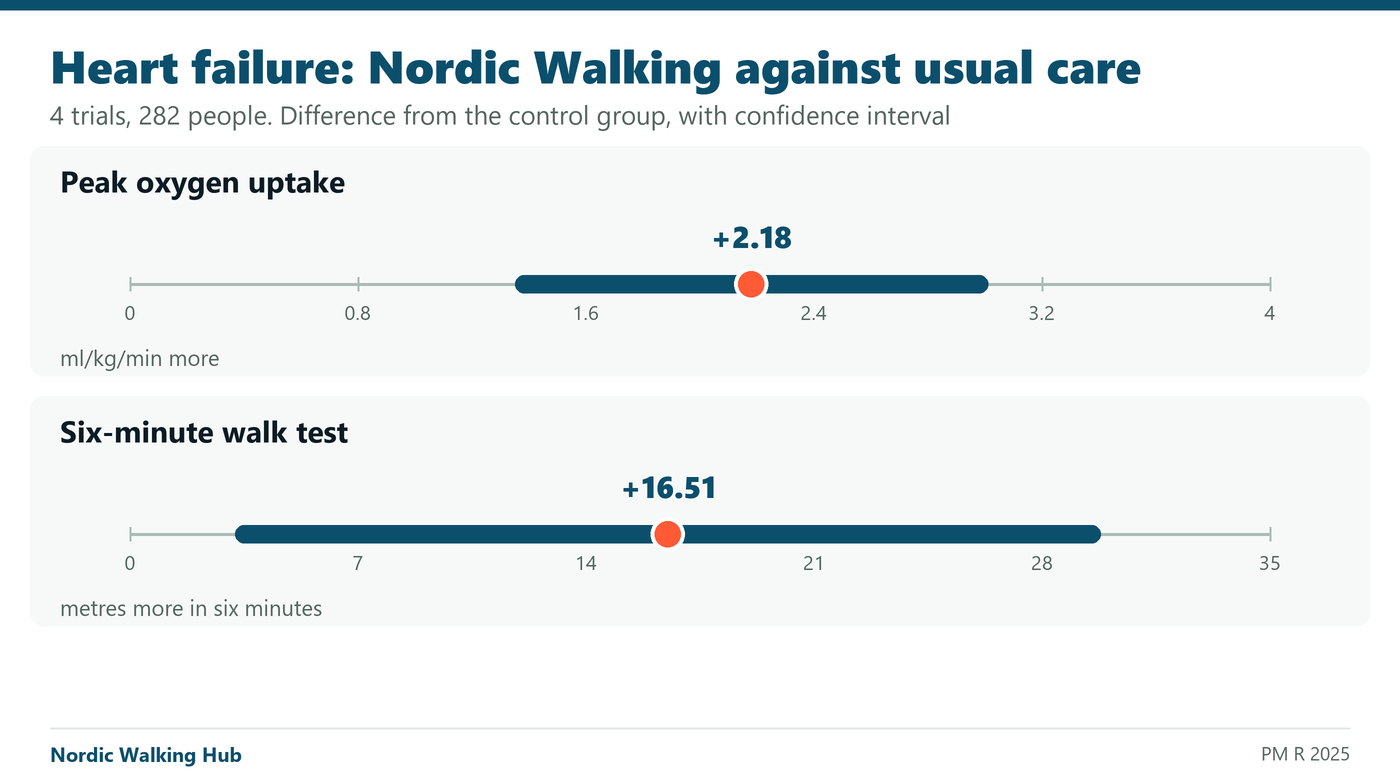
- Peak oxygen uptake rose by 2.18 ml/kg/min more than in the control groups, the six-minute walk by 16.5 metres more.
- The differences are not huge, but they point in the same direction. The authors call it a possibly useful part of cardiac rehabilitation.
- Studies are few, which is why larger ones are needed.
Who it is for
The review concerns people with chronic heart failure and a reduced ejection fraction. That means the heart pumps out less blood with each beat than it should. Such people often get tired doing things that used not to be a problem: stairs, shopping, a walk with the grandchildren. It is precisely for them that it is important to find movement they can manage and that will help them.
What the review did
The authors searched three large databases and chose only randomised trials, that is ones in which who walks with poles and who does something else was decided by lot, not by the wishes of the people or the doctors. That makes the groups fairly comparable. They found four such trials, with 282 people in total. Nordic Walking was compared with standard cardiac rehabilitation or usual care.
What the review found
- Peak oxygen uptake, a measure of how much effort the body can manage, rose by 2.18 ml/kg/min more with Nordic Walking than in the control groups. The confidence interval was 1.35 to 3.01, so the true difference is probably somewhere in that range.
- The distance in the six-minute walk test, that is how many metres you cover in six minutes, increased by 16.51 metres more. Here the interval is wider, 3.23 to 29.80 metres: the true difference may be small, but also almost thirty metres.
The differences are not huge, but both point in the same direction, and that is the point: people who walked with poles did slightly better after the programme than those who did something else. The authors sum it up by saying that Nordic Walking may be a useful part of cardiac rehabilitation.

How to read it
Four studies are few, and the authors themselves write that larger studies with more varied patients are needed. So today we do not know whether the result would be the same for everyone. A meta-analysis adds up the results of several studies and works out a combined number, which is more reliable than the result of one small study. But four studies are still only four. Still, the numbers suggest that Nordic Walking can be a useful part of cardiac rehabilitation, and that is news worth having.
Why it makes sense
It is logical, even though the studies did not examine it: walking with poles is a movement that many people can manage who might not have the strength for running or cycling, and it can be done in a group and outdoors. Both matter for a long-term habit. Nothing is promised, but there is logic to it.
What it means
It is an encouraging signal, not a ready-made guide. Nothing is promised, and how and how much is decided by the people who treat and guide you. Poles offer movement that can be dosed in small steps and needs no equipment other than the poles.
Do you walk with poles and your heart no longer works at full strength? Tell us in the forum how it is going and how you are starting. More than any study, the experience of someone in the same situation as you is useful.
Frequently asked questions
**May I walk with poles if I have heart failure?** The studies show that people with chronic failure and a reduced ejection fraction walked in the pole trials and did slightly better than the control groups. The individual pace and dose, though, are set by your condition, not by a table, which is why it pays to start slowly.
**Is it better than usual rehabilitation?** The review does not say “better”. It says it came out somewhat higher for fitness and distance, but there are only four trials. Poles are not a replacement for rehabilitation, but they can be part of it.
**Why are the studies so small?** Studies of sick people are hard to do and take a long time. The more people and the more varied the group, the more reliable the result. That is why the authors ask for larger studies.
**What will it bring me in everyday life?** The six-minute walk test improved by 16.5 metres. That is not a huge gap, but it shows the body manages slightly more. In practice that may mean you manage stairs or shopping with less breathlessness.

Text: Kompas.

Join the discussion
Members can comment. Log in or create a free account.