


Poles are often recommended to older people for confidence when walking. But what of that actually holds? A review that compared Nordic Walking with doing nothing, with walking without poles and with strength training gives an answer with a few pleasant surprises and one warning. Fifteen studies with people from sixty to ninety-two.

In brief
- Fifteen studies, people from 60 to 92. According to the authors Nordic Walking is a safe and accessible aerobic activity for seniors.
- Against doing nothing it improved fitness, strength, balance in walking, blood fats and quality of life.
- Against walking without poles it improved steadiness of step and mobility, but for fitness walking without poles was better.
- Static balance standing still rather got worse: poles train walking, not standing on one leg.
What the review did
The authors searched six large databases for Nordic Walking combined with age terms and chose fifteen English-language studies from scientific journals. The age of participants was 60 to 92. They wanted to know how Nordic Walking changes physical fitness, body composition and quality of life, in three comparisons: with people who do nothing, with people who walk without poles, and with people who exercise with resistance, that is strength training. The numbers are effect sizes: the further from zero, the greater the difference.
Against doing nothing
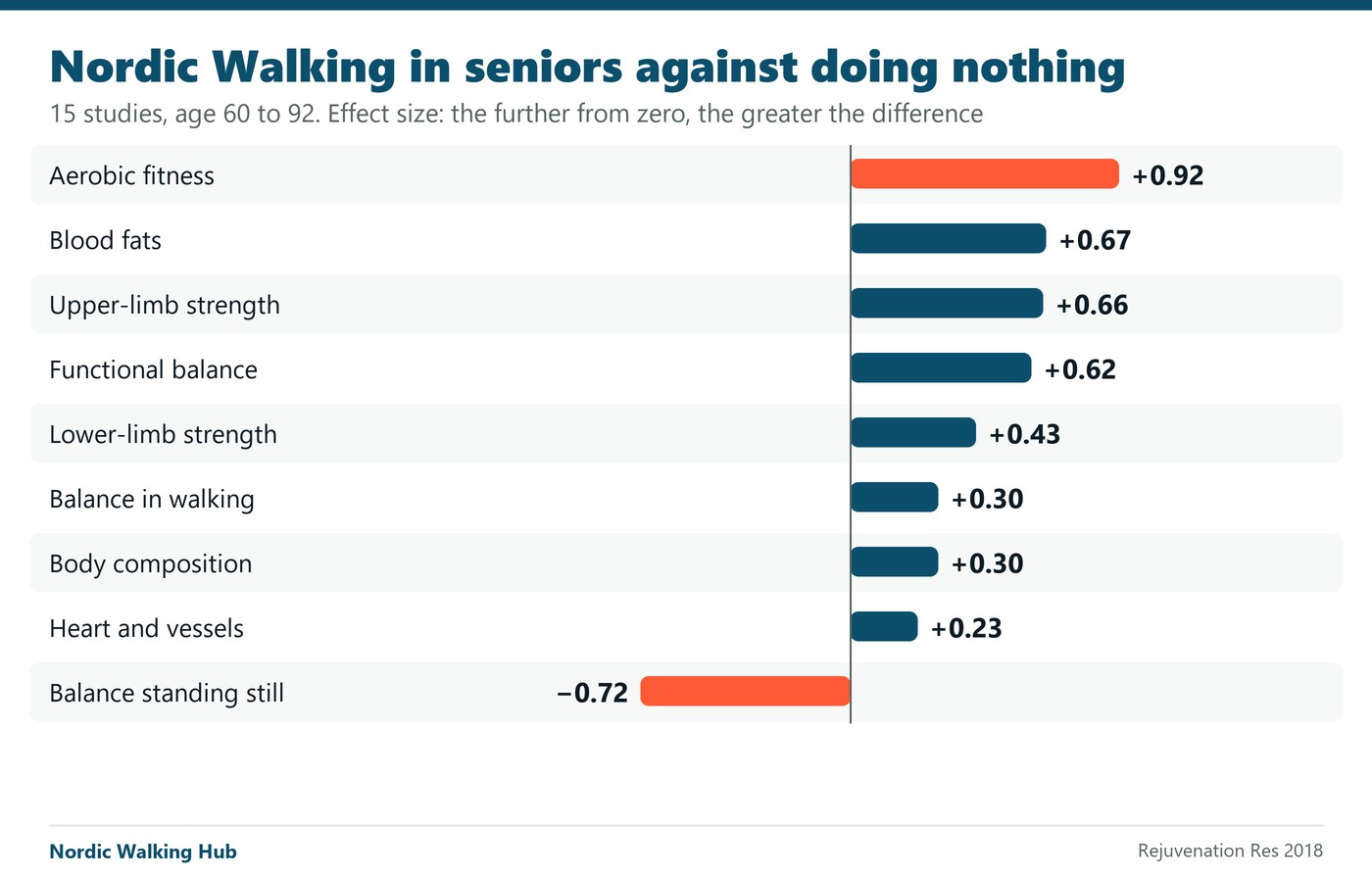
Compared with an inactive group, Nordic Walking improved:
- aerobic fitness (0.92),
- strength of the upper (0.66) and lower limbs (0.43),
- balance in walking (0.30) and functional balance (0.62),
- blood fats (0.67), body composition (0.30) and heart and blood vessels (0.23).
Aerobic fitness came out highest, and that makes sense: walking with poles means more muscles engaged, and so more work for the heart and lungs. Strength of the upper limbs is a welcome bonus for seniors who do not otherwise load their arms much.
Against walking without poles
Compared with walking without poles, Nordic Walking improved balance in walking (0.30), flexibility of the lower half of the body (0.47) and quality of life (0.53). Walking without poles was better in aerobic fitness (−0.21). In other words: poles help you with steady steps and with mobility, but for breath and heart, faster walking without them gives you more.
Against strength training
The comparison with strength training is interesting. Compared with it, Nordic Walking improved balance in walking (0.33), strength of the lower half of the body (0.39), aerobic fitness (0.75), mobility of the upper half of the body (0.41) and quality of life (0.93). Quality of life came out highest of the whole review. That is important: for a person who would never sign up for a gym, walking with poles is a way out, among people and into fresh air.
An interesting extra result
Balance standing in place, that is static balance, rather got worse after Nordic Walking compared with the inactive group (−0.72). The authors do not explain it. It makes sense to remember it, though: poles train walking, not standing on one leg. When a person learns to rely on poles, standing without them may go worse.
What it means
The authors call Nordic Walking a safe and accessible aerobic activity for seniors. If you feel unsteady standing, practise balance separately, for example by brushing your teeth on one leg next to a firm support. That is our advice, not the review’s conclusion, but it follows from what the numbers showed.
The numbers in the review are averages, but you are a particular person. If after a few weeks you feel steadier on stairs, in a shop or on a slippery pavement, that is the best yardstick you have, and no study can take it from you.
Are you over sixty and walk with poles? Tell us in the forum what walking has given you and what surprised you. Older walkers are most welcome with us.
Frequently asked questions
**Is Nordic Walking for people in their eighties?** The review included people from 60 to 92. The authors call Nordic Walking a safe and accessible aerobic activity for seniors. For someone in their eighties, though, walks at their own pace and on their own terrain are decisive.
**Will poles help against falls?** The review did not measure that directly. Balance in walking improved, but static balance standing still got worse. So poles help you walk, not stand. If you are afraid of falls, practise balance separately.
**Should I rather walk with poles, or walk fast without them?** It depends on the goal. For breath and heart, brisk walking without poles is better. For steady steps, mobility and quality of life, poles are better. And for someone who does not dare walk fast, poles are often a way to move at all.
**Is it better than a gym?** In the review Nordic Walking came out better than strength training in quality of life. But that does not mean you should not do strength training. The two complement each other.

Text: Kompas.

Join the discussion
Members can comment. Log in or create a free account.