


Winter is no reason to leave your poles at home. On slippery, uneven ground you will be glad to have two extra points of support in your hands. To make it pleasant, a few small adjustments help, and none of them costs much. And we say that winter is the nicest time for Nordic Walking: the silence, frost in the air and paths that nobody sees in summer.
In brief
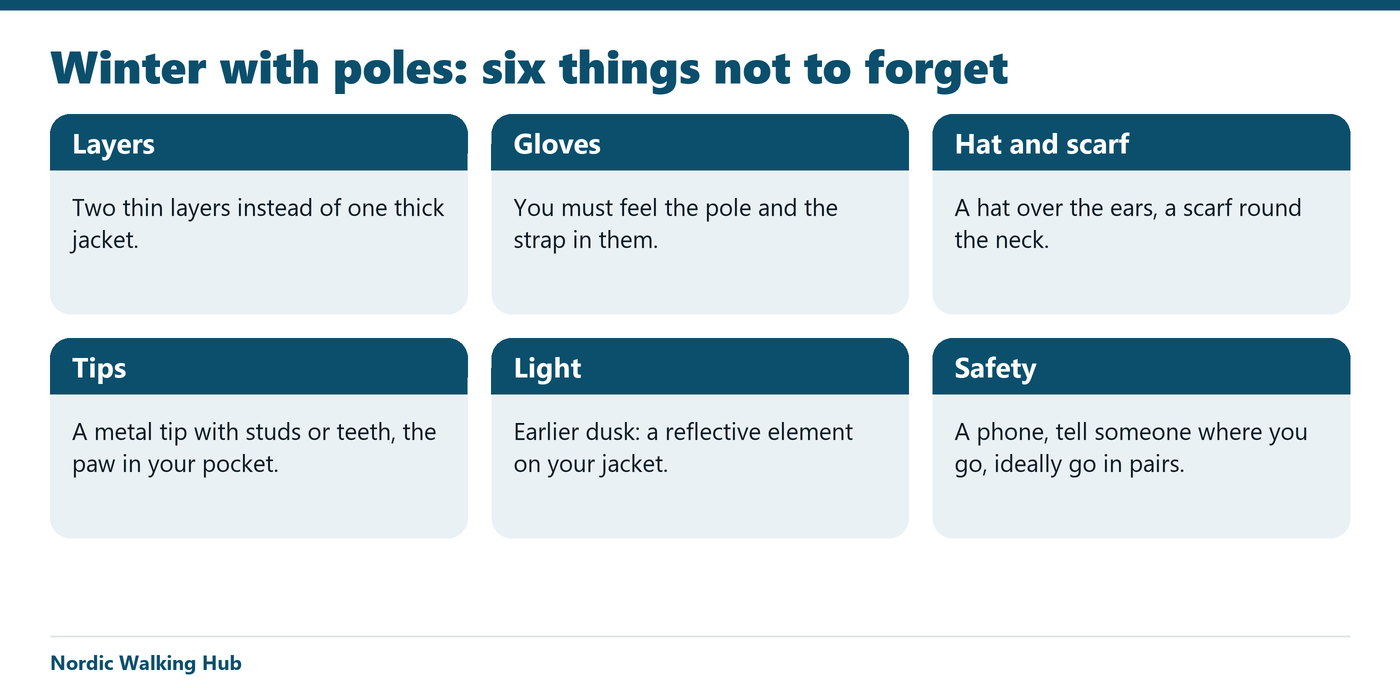
- Two thin layers instead of one thick jacket, gloves in which you feel the pole, a hat over the ears.
- On ice and packed snow a metal tip with studs or teeth, the paw in your pocket. Baskets for deep snow.
- Shorten your stride, expect earlier dusk, have your phone and tell someone where you go. Ideally go in pairs.
- Two to three walks a week of 20 to 40 minutes are enough.
What to wear
Try two thin layers instead of one thick jacket. When you warm up you take one off, and your arms keep moving freely. That is what matters most when walking with poles: a bulky jacket that stops you swinging your arms takes away half the joy of the movement.
Choose gloves that let you feel the pole and the strap. If you cannot loosen your grip in them, they are too thick for Nordic Walking. And a hat that covers your ears has saved many a walk. A scarf round your neck and spare thin gloves in your pocket come in handier than you would expect.
Tips and paws
Rubber paws are great on tarmac but they slide on ice and packed snow. There you want a metal tip, ideally with pronounced teeth or studs, that bites into the surface. You do not need new poles: most good poles come with both paws and tips, so you simply take the paw off and put it in your pocket. When you are back on the pavement, you put it on again.
For deeper snow baskets help, wide discs just above the tip that stop the pole sinking in. For ice there are special traction spikes too, screwed on in place of the ordinary one. More about this in the article Tips and paws.
One warning: a sharp tip likes to get stuck in wet mud, and in winter, when snow alternates with muddy paths, that happens. Nothing dramatic, just expect it.
So the walk ends well
- On icy ground shorten your stride and walk slower. The poles help, but they do not replace caution.
- Expect earlier dusk. A reflective element on your jacket or backpack is a simple safeguard.
- Take your phone and tell someone where you are going. Even better, go with a friend or a group.
- Drink in winter too. Many people forget in the frost that they sweat just as in summer.
How long and how often
Winter is a good time for shorter, calmer walks. Two to three walks a week of 20 to 40 minutes at an easy pace are recommended for beginners, and in winter that goes double. Do not chase the clock, the point is that you still feel like going out next time. Regularity matters more than length.
The winter magic
A winter walk has its own charm: the silence, frost in the air, snow creaking under your boots, and a hot tea afterwards that tastes different from the one in summer. It is worth heading out even when the sofa is calling. The hardest part is usually getting to the door. Once you are through it, the rest comes by itself.
Do you walk in winter? Tell us in the forum which layers and tips worked for you. Your experience is worth more than any advice from a guide.
Frequently asked questions
**Can I walk with poles on ice in winter?** Yes, with a metal tip, ideally with studs or teeth. Shorten your stride and walk slower. Poles are a support, but they are not a guarantee.
**How should I dress when it is minus ten?** Two thin layers and a hat. Gloves in which you can feel the pole. If it is really bitterly cold, choose a shorter walk and movement in which you warm up.
**Is winter Nordic Walking safe?** With a sensible approach, yes. Ice and dusk are the riskiest. A reflective element, a phone and going in pairs reduce the risk.
**Should I drink when it is cold?** Yes. In the frost a person sweats just as in summer, they just do not notice. A small sip of something warm from a flask works wonders.
What to leave at home
What slows you down most on the way are the things you take “just in case”. A heavy flask, five extra layers and two pairs of spare gloves turn you into a person who does not set out because it is too complicated. Take only what you really need: a thin extra layer, gloves, a phone and something warm to drink. Leave the rest at home and set out.
A winter walk does not have to be long: half an hour after work is enough, and because of the dark you will not get far anyway. Above all, do not let it become a duty.
Text: Kompas.

Join the discussion
Members can comment. Log in or create a free account.