


More than half of adults had neck pain in the last six months. Sedentary work at a computer makes it worse: head forward, shoulders up, back in an arch, and that for eight hours. Will poles help, or is it just another piece of advice that sounds good? A small trial from Norway gave a fairly interesting answer.
In brief
- A pilot trial, 34 office women with neck and shoulder pain, ten weeks, twice a week for 30 minutes.
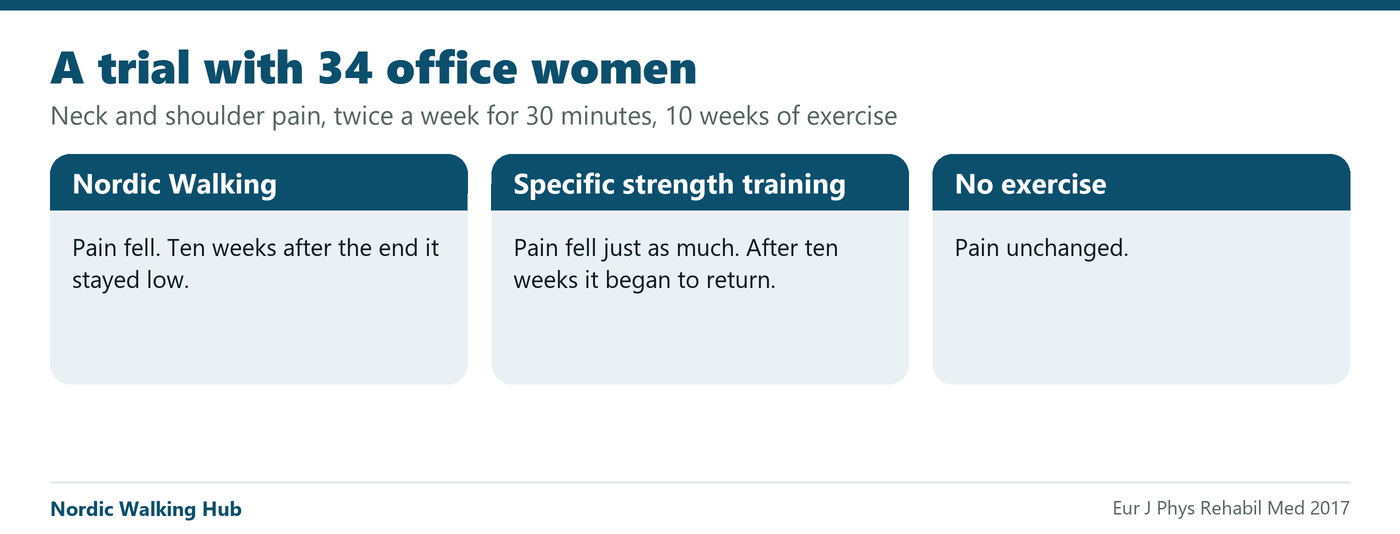
- Nordic Walking reduced pain as much as specific strength training. Without exercise the pain did not change.
- After the end the pain stayed low in the walkers and began to return in the strength group.
- It is a small trial. It does not say that poles cure the neck, it says that half an hour of movement twice a week appeared useful.
Why the neck hurts
A sedentary job is the enemy of the neck and shoulders. The muscles around the neck hold a head that weighs several kilograms, and when you sit motionless for hours they tire and stiffen. That specific strength training of the muscles in the neck and shoulder area relieves pain is already known. Less studied was movement that rather stretches and perfuses the muscles than loads them.
What the trial did
Norwegian authors divided 34 office women with neck and shoulder pain by lot into three groups: Nordic Walking, specific strength training and no exercise. Both exercising groups exercised twice a week for 30 minutes over ten weeks. So no marathons, but what can be fitted in even alongside work.
Several things were measured: pain intensity on a scale from 0 to 100 millimetres, strength in raising the arm to the side and performance in the six-minute walk test. All before the programme, after it and again ten weeks after it ended.

Results
- In both exercising groups pain fell similarly and significantly.
- In the control group pain did not change.
- Over a further ten weeks the pain in the pole walkers stayed the same, and in the strength group it came back (not significantly).
- Strength and performance in the six-minute walk test did not change.
It is interesting that walking with poles came out as good as specific strength training of the neck and shoulders. Strength training requires someone to teach the exercises and the person to do them correctly, whereas walking with poles is simpler. And one detail deserves attention: in the walkers the pain stayed low after the programme ended, while in the strength group it began to return. It is a small difference and statistically not significant, but it shows a direction.
How to read it
It is a pilot trial, small, with one group of people, and the authors themselves ask for larger studies. It does not say that poles “cure” the neck. It says that half an hour of movement twice a week appeared useful and that walking was as good as strength training. The women in the trial were office workers with low-intensity pain, so the result applies mainly to people in a similar situation. The fact that neither strength nor performance changed should warn us against exaggeration: it is not about training, it is about getting the body moving again.
What it means
Anyone who sits at a monitor all day has a good reason to head out for half an hour with poles. The shoulders loosen while walking, the head comes up and the eyes look somewhere other than a screen. The trial did not measure that last part, but it sounds reasonable.
How to do it in practice: half an hour twice a week is nothing that cannot be fitted into a week, say in a lunch break, after work or at the weekend. The trial did it at fixed times, and that may be the main thing. Write down two days in advance and treat them as a meeting you do not cancel. You can simply take the poles to the office.
Do you work at a computer and does your neck hurt? Tell us in the forum what helps you, whether it works or not. More heads know more.
Frequently asked questions
**Is it enough to walk with poles, or do I have to strengthen too?** In the trial Nordic Walking came out as good as specific strength training. But strength training requires someone to teach the exercises. Walking with poles is simpler to begin with. Ideally do both, if you enjoy both.
**How often?** In the trial twice a week for thirty minutes. That is a piece that can be fitted even into a hectic week. A fixed appointment helps more than a good intention.
**Is it only for women?** The trial concerned office women, because they were the ones with pain. It does not mean men have no claim, the study just did not focus on them.
**What if the pain persists?** Nordic Walking is not a medicine and nobody sells it as one. If the pain persists even after months of regular movement, try adding strength training, which worked just as well in the trial.

Text: Kompas.

Join the discussion
Members can comment. Log in or create a free account.